

If you’re a CIO or IT leader, you probably know the feeling already – that slow dread when Salesforce announces an update, or NetSuite rolls out a new version, and someone from your team says, “We need to check all the integrations.” It’s a small sentence with big consequences. Suddenly your roadmap slides, teams scramble, and your integration layer – the thing meant to connect your enterprise – becomes the thing holding it back. But here’s the twist: it doesn’t have to be this way. Not when modern integration behaves less like legacy software… and more like your iPhone.
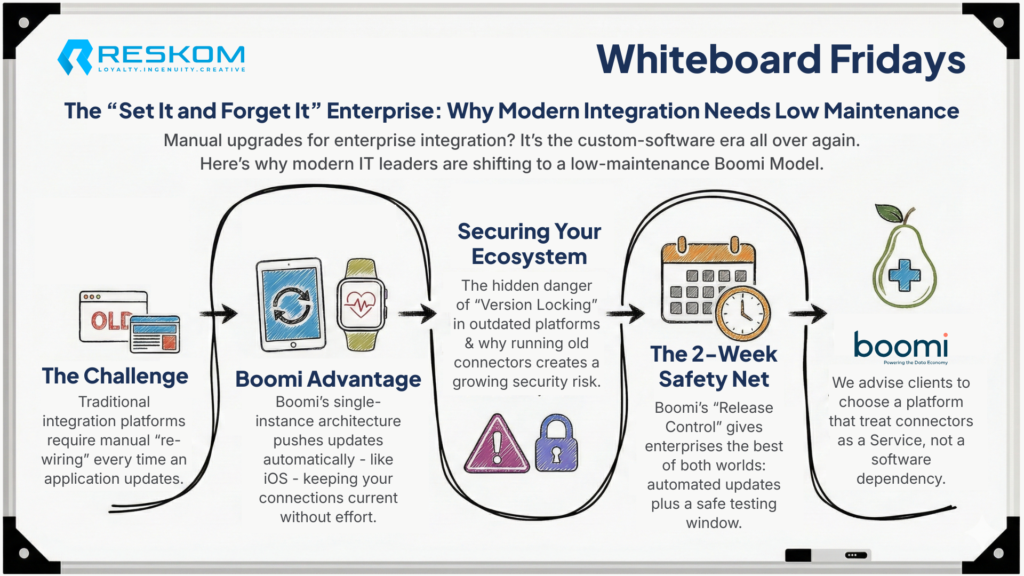
The Invisible Burden
Why traditional integration platforms require manual "re-wiring" every time Salesforce or NetSuite updates
Here’s the thing no one admits upfront: most traditional integration platforms weren’t built for the SaaS world. Every time Salesforce tweaks an API or NetSuite changes an object, your connectors need “re-wiring.” Not theoretically – literally. Teams open old code, re-map fields, test payloads, run patch jobs, and pray nothing else breaks. It’s duct-tape engineering at enterprise scale. And the worst part? None of this work adds new value. It’s maintenance for the sake of survival. So the more SaaS you adopt, the more your integration layer becomes a full-time job. The burden is invisible… until it isn’t.
The "SaaS" Difference
How Boomi’s single-instance architecture pushes updates to you automatically
Now flip the picture. Imagine your integration platform updating itself the way your iPhone updates overnight. No Jira tickets. No weekend releases. No war rooms. That’s what Boomi’s single-instance, multi-tenant architecture does. When Salesforce changes something, Boomi updates the connector for everyone – globally – in one stroke. You don’t “upgrade” it; you simply receive it. Think of it as living in a world where the roads repair themselves while you’re asleep. Your integrations don’t fall behind because the platform won’t let them. For CIOs exhausted by patch cycles, this is the difference between chasing change… and staying ahead of it.
Risk vs. Reward
The hidden danger of "Version Locking" in code-centric platforms
Here’s where things get risky. Code-heavy integration tools let you pin connectors to older versions. Sounds convenient. Except it quietly turns into a security hazard. Old connectors don’t get protocol fixes, security patches, or object updates. Suddenly your integrations are running on outdated plumbing – the digital equivalent of ignoring a cracked pipeline. Attack surfaces widen, compatibility shrinks, and upgrades become multi-week projects that no one wants to approve. Version locking feels safe in the moment but dangerous in the long run. Modern enterprises can’t afford to run integrations that age faster than their business needs.
The 2-Week Safety Net
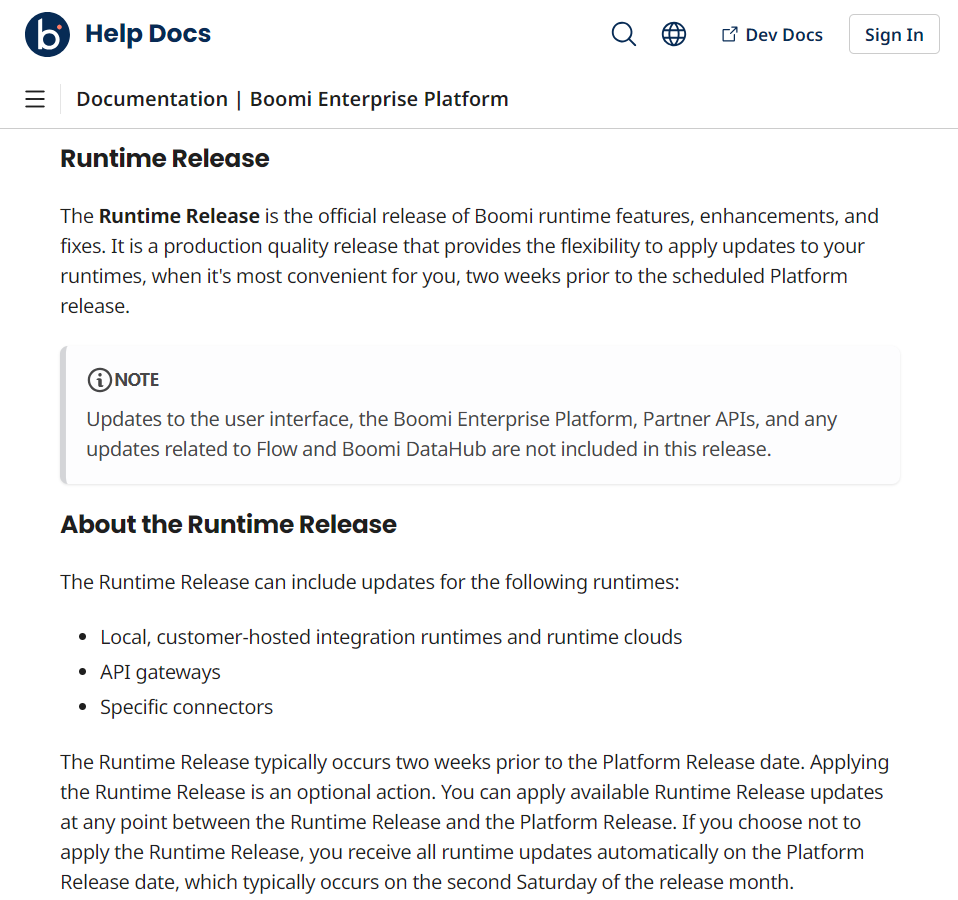
How Boomi’s Release Control gives enterprises the best of both worlds
Source: Boomi Help Docs
Automated updates sound magical… until someone asks, “But what if it breaks something?” Fair question. Boomi solves this with Release Control – a built-in two-week buffer that lets you preview the new connector behavior before it applies to production. It’s like receiving an iOS beta before the public release. Your teams can test, validate, and call out issues while the old connectors still run. After two weeks, everything updates automatically. No upgrades, no patch windows, no deployment schedules. Just safe automation. The platform stays modern by default, without dragging your enterprise into a constant testing-and-upgrading loop.
RESKOM’s Take
Why we advise clients to choose platforms that treat connectors as a Service
At RESKOM, we see this pattern repeatedly – enterprises don’t struggle because integrations are complex. They struggle because integrations behave like old-school software: fragile, versioned, and dependent on human intervention. Our recommendation is simple: choose platforms where connectors are treated as a service, not a software dependency. When updates flow continuously, your integration landscape stays evergreen. Your teams spend time on business acceleration, not plumbing fixes. We’ve seen clients cut maintenance effort by half simply because they stopped owning connector upgrades. The future enterprise isn’t “always upgrading.” It’s “always updated.” There’s a quiet but powerful difference.
The dream of “set it and forget it” isn’t fantasy anymore. It’s what modern integration looks like when the platform carries the maintenance burden, not your teams. If you’re planning next year’s integration strategy, maybe it’s time to stop chasing updates – and start choosing a platform that updates itself.
Want to explore whether your business is ready for this shift? Reach out to Most Trusted Boomi Implementation Partner RESKOM – we’ll walk you through it.