

Digital transformation efforts experience bottlenecks not due to intent, but because of execution constraints. Across enterprise transformation programs, this execution gap is one RESKOM repeatedly observes in complex, multi-system environments. As enterprises adopt cloud, SaaS, and data-driven platforms, IT landscapes become more distributed and complex. Conventional, hand-coded integration methods struggle to keep pace – introducing long delivery cycles, growing backlogs, and dependence on scarce development skills.
Integration has emerged as a critical architectural control point rather than a back-end concern. Fusing legacy systems, modern applications, APIs, and data flows at scale requires speed, consistency, and governance – capabilities that traditional development models were not created to deliver. Low-code integration platforms like Boomi target this gap and have strategic relevance.
This blog brings to you RESKOM’s perspective, based in enterprise integration experience, on how low-code platforms support scalable digital transformation, modernize legacy environments, and lay the foundation for AI-driven automation and future-ready enterprise architectures.However, before an organization can realize this future-ready state, it must first confront the structural hurdles that have historically slowed progress.
The Underlying Constraints
From an enterprise perspective, transformation challenges tend to follow predictable patterns. Organizations aim to digitize efficiently, but sometimes fail because of:
The Agility Gap
Traditional software development remains resource-heavy and sequential by design. In a highly volatile landscape, this leads to slow release cycles and growing IT backlogs. For CIOs, this often means that there is as an inability to align IT delivery timelines with business priorities. The result is a widening gap between business expectations and the organisation’s ability to deliver change expeditiously.
The Integration Challenge
Enterprises of today run across fragmented technology ecosystems – combining legacy platforms, cloud services, SaaS applications, and partner systems. With every new system involved, integration complexity increases. Hand-coded integrations take time to build and are difficult to maintain, consuming inordinate IT capacity and reducing architectural flexibility. These hidden integration expenses often appear later as technical debt and operational risk.
The Talent Issue
There’s a shortage of skills and talent. Organisations rely on specialised integration and development expertise that is difficult to hire and retain. This creates key-person dependencies and operational fragility, eventually giving way to operational risk.
These constraints “agility, complexity, and talent” form a ‘glass ceiling’ on digital growth. Low-code integration platforms like Boomi are designed to shatter this ceiling by shifting integration from a manual craft to a governed, scalable enterprise capability.
Low-Code Integration
Low-code integration platforms like Boomi empower organisations to connect applications, data, and processes using visual, configuration-driven tools rather than extensive custom code. From an enterprise IT standpoint, this shifts integration from a tailor-made activity to a governed capability. They are framed to quicken integration and delivery while preserving enterprise-grade security, governance, and scalability.
By connecting visual modelling, reusable components, and pre-built connectors, these platforms standardise integration patterns, reduce development effort and improve delivery predictability. For CIOs, this introduces greater control, transparency, and repeatability at the integration layer.
Core Dimensions of Low-Code–Led Digital Transformation
Turning Agility into a Competitive Advantage
Organisations can save 50–90% of their development time compared to using traditional coding languages. Teams can rapidly prototype, deploy, and enhance integrations as business requirements change, enabling faster response to market shifts and regulatory change without reengineering entire systems.
Broadening Ownership of Innovation
Organisations can save 50–90% of their development time compared to using traditional coding languages. Teams can rapidly prototype, deploy, and enhance integrations as business requirements change, enabling faster response to market shifts and regulatory change without reengineering entire systems.
Establishing a Common Integration Language
Low-code platforms offer a shared, visual language that enhances collaboration between technical and non-technical teams. This collaboration reduces misinterpretation of requirements and shortens delivery cycles. For IT leaders, this translates into fewer rework cycles and more predictable outcomes. IT’s role evolves from an execution role to a strategic enabler, managing standards, security, and scalability.
Modernising Legacy Environments
Instead of totally eradicating legacy systems, low-code integration platforms act as an abstraction layer. They encourage organisations to reveal legacy functionality through APIs and integrate with modern cloud services, lengthening the value of existing investments while enabling gradual modernisation.
While the architectural advantages of this ‘wrapper’ approach are clear, the shift to low-code also fundamentally rewrites the economic equation of IT.
Economic and Strategic Benefits
Cost Reduction
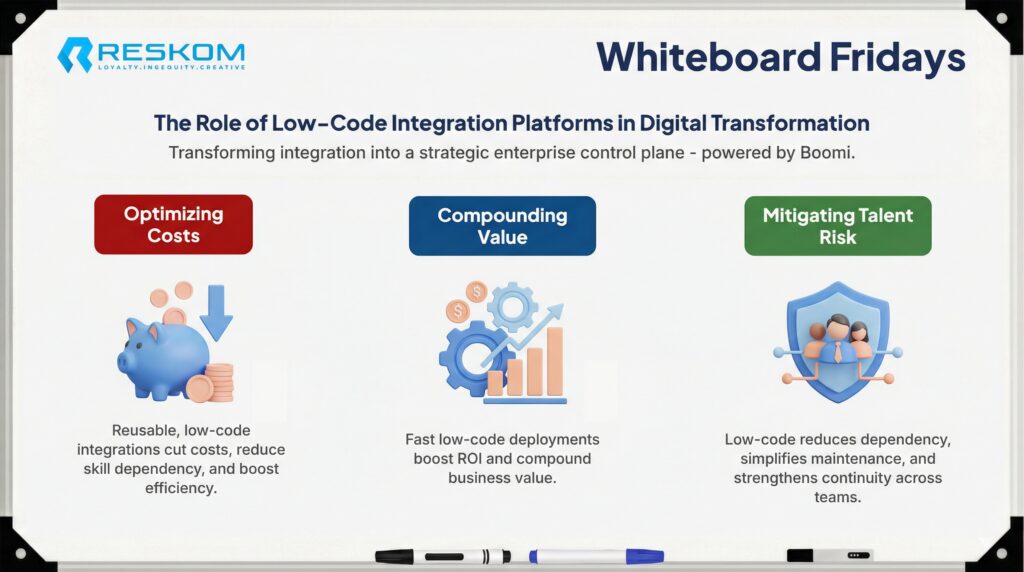
By tweaking large portions of custom integration code with components that are reusable and configuration-focused, organisations reduce the effort required to design, build, and test applications and integrations. This lowers development costs and lessens the dependency on highly specialised, scarce developer skills. This directly boosts cost transparency and delivery efficiency – key CIO concerns. IT teams can bring more results with available resources, improving cost efficiency without escalating operational risk.
High ROI
When integrations and automations are deployed in days or weeks rather than months, the payback period on digital initiatives shortens. Studies have brought to the forefront that organisations using low-code platforms can reach ROI improvements of up to 60% through faster delivery. This accelerated value realisation lets organisations fund further innovation using gains from earlier initiatives, creating a compounding return on digital investments.
Reducing Key-Person Dependency Risk
In traditional coding, if a developer leaves or documentation is limited, their custom code can become difficult to maintain over time. Low-code provides a standardised, visual layout that is easy for new staff to understand and maintain. This boosts continuity, reduces knowledge silos, and lowers the long-term cost and risk of system maintenance.
Beyond immediate cost efficiencies, the most profound impact of a low-code foundation is how it prepares the enterprise for the next frontier: AI-driven orchestration.
Future-Proofing: AI and Automation
AI Integration
Low-code platforms are embedding AI. This includes ‘Agentic AI’ – autonomous digital workers that can plan and carry out complex tasks across applications. From a platform maturity angle, this indicates a move from integration execution to intelligent orchestration.
Automation
These tools allow for the creation of intelligent workflows that automate repetitive back-end logic, such as loan approvals or supply chain tracking. This enables IT teams to scale automation without increasing system complexity.
Critical Considerations for Implementation
To ensure this newfound speed does not lead to chaos, the narrative must include a chapter on governance. Speed without control is a liability; speed with Boomi’s enterprise-grade security is a competitive advantage.
To prevent the emergence of ‘shadow IT’, organisations should set up definite governance models for low-code adoption. Modern platforms provide enterprise-grade security, access controls, and compliance capabilities that define who can build, deploy, and modify integrations. For CIOs and CISOs, this ensures speed does not come at the cost of control. Reputable platforms such as Boomi are designed with sturdy privacy controls and adherence to industry standards, ensuring strict security.
Beyond immediate cost efficiencies, the most profound impact of a low-code foundation is how it prepares the enterprise for the next frontier: AI-driven orchestration.
RESKOM’s Take
As low-code adoption becomes a strategic imperative rather than an operational improvement, organisations that properly utilise its capabilities will be better positioned to navigate complexity and capture new opportunities. Much like a well-designed transport network enables a city to grow without congestion, low-code integration provides the connective foundation that allows digital initiatives to scale without friction.
For enterprises, this foundation determines how confidently and sustainably transformation can progress. When considered with the right architectural intent and governance, low-code integration evolves into a foundational enterprise capability.
By closing the execution gap that so often stalls digital progress, low-code integration transforms IT from a cost center into an engine of growth. At RESKOM, we don’t just connect systems; we build the architectural resilience required for the modern enterprise.
Want to explore whether your business is ready for this shift? Reach out to Most Trusted Boomi Implementation Partner RESKOM – we’ll walk you through it.