
How Gartner’s Digital Vanguard Framework Reveals the Mid-Market Strategic iPaaS Integration Imperative – and Why Boomi’s Architecture, which we at RESKOM Implement, Uniquely Address All Four Success Pillars
This is the first installment of a two-part series dedicated to helping mid-market CIOs bridge the critical gap separating Digital Vanguard leaders from laggards. In this part, we at RESKOM analyze the four Digital Vanguard Imperatives, expose the common failure modes of traditional integration, and detail how a unified platform like Boomi is uniquelydesigned to address all four simultaneously.
The 23-Point Success Gap Your Board Needs to Understand
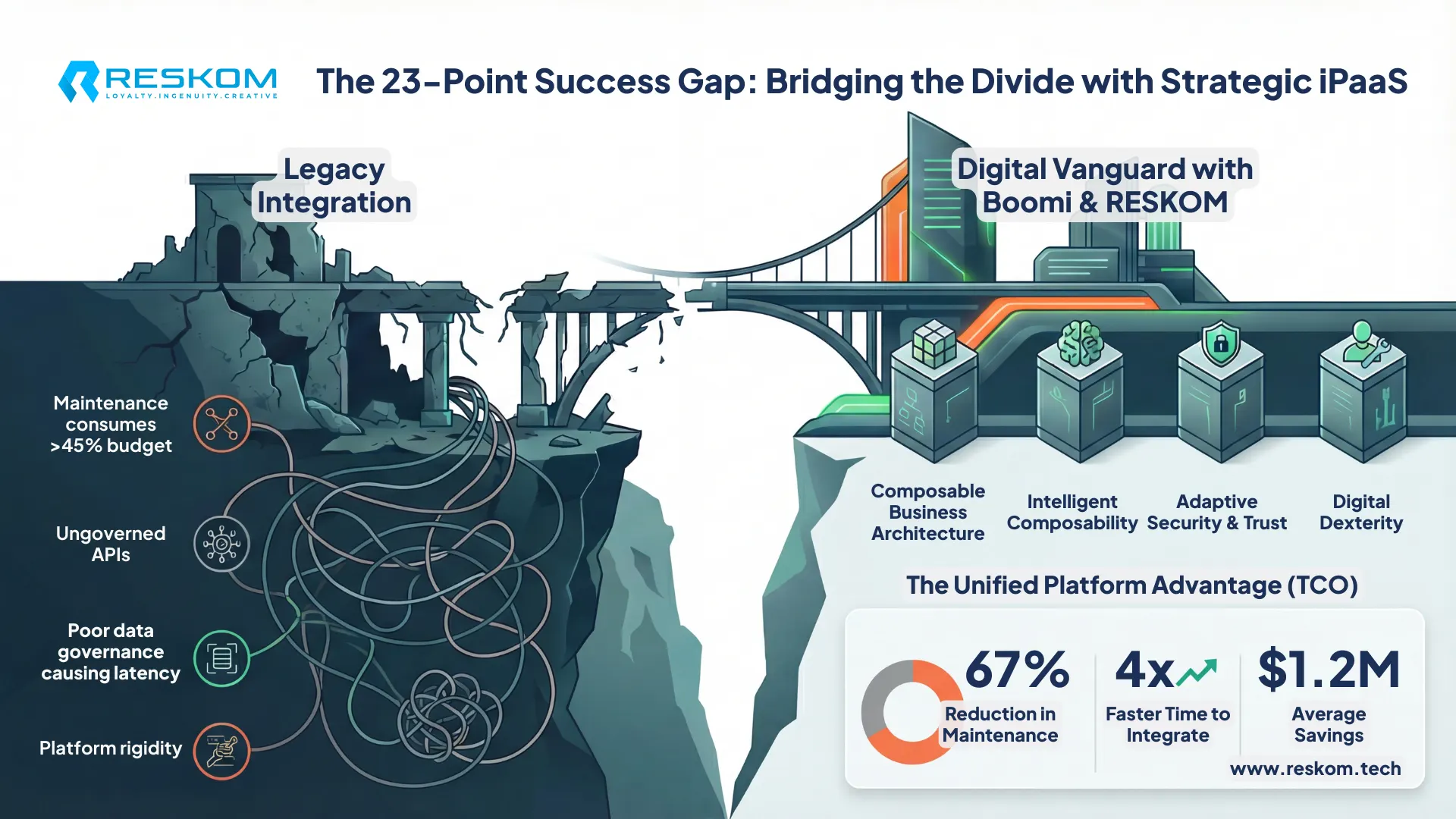
Gartner’s Digital Vanguard research identifies a stark reality: organizations that excel at four specific imperatives achieve 71% success rates in digital transformation, compared to just 48% for those who don’t. That’s a 23-percentage-point gap that separates market leaders from laggards.
But here’s what Gartner’s framework doesn’t explicitly state: In practice, all four imperatives consistently break down without a composable integration backbone..
For mid-market CIOs ($50-500M revenue), this creates a strategic paradox: you need enterprise-class integration capabilities to execute on Digital Vanguard principles, but you’re operating with 40-60% less budget and 30% fewer technical resources than Fortune 500 peers, making the challenge less about whether those capabilities are needed and more about whether they can be delivered within mid-market economic and operational constraints
The question isn’t whether to invest in iPaaS. It’s whether your integration platform architecture can actually deliver on all four Digital Vanguard imperatives simultaneously – or whether you’re building a beautiful house on a crumbling foundation.
Why Traditional Integration Approaches Fail the Vanguard Test
Before we examine how Boomi's platform architecture specifically addresses each imperative, let's acknowledge why legacy integration approaches systematically fail:
The Four Failure Modes:
- Point-to-Point Death Spiral (affects Imperative #1 & #3)
- Each new application requires 3-7 custom connections
- Integration complexity grows exponentially: 10 apps = 45 potential connections
- Mid-market reality: 47% of integration budget consumed by maintaining existing connections before adding new capabilities
- API Chaos Without Governance (affects Imperative #2 & #4)
- Ungoverned API sprawl: average mid-market organization has 187 APIs with zero centralized visibility
- Security exposure: 34% of APIs lack proper authentication protocols
- No reusability: developers rebuild identical integration logic 4-7 times across different projects
- Siloed Data, Siloed Decisions (affects all four imperatives)
- Average data latency between systems: 18-72 hours
- Real-time decision-making becomes impractical when customer data exists in 9 different systems with no unified view
- Business agility paralyzed: simple changes require 6-8 week integration projects
- Platform Rigidity in a Composable World (affects Imperative #3)
- Legacy ESB/middleware requires 6-12 months to onboard new SaaS applications
- No low-code capabilities: every integration change requires scarce developer resources
- Struggles to support rapid business model pivots or M&A integration scenarios at mid-market speed
The Four Digital Vanguard Imperatives - Through an Integration Lens
Imperative #1: Composable Business Architecture
Gartner Definition: Build modular capabilities that can be rapidly reconfigured
Integration Reality Check:
- 63% of mid-market “composable” initiatives fail because the integration layer isn’t composable
- You cannot have composable business capabilities running on monolithic integration infrastructure
- True composability requires: packaged business capabilities (PBCs), reusable APIs, and event-driven architecture
How Boomi Enables This:
- Pre-built Connector Ecosystem: 300+ certified connectors eliminate 70-80% of custom integration work for common SaaS applications (Salesforce, NetSuite, Workday, SAP, ServiceNow)
- Process Library & Templates: Accelerate time-to-value by 60% with reusable integration patterns
- API Management Built-In: Unified platform for building, publishing, securing, and governing APIs – no separate API gateway required
- Flow Services: Low-code canvas for business users to assemble workflows from pre-built integrations without writing code
Diagnostic Question for CIOs: Can you deploy a new SaaS application (CRM, ERP, HCM) and achieve bi-directional data sync with existing systems in 4 weeks or less?
- If no → Your integration architecture is blocking composable business capabilities
- If yes → You likely have strategic iPaaS in place
Imperative #2: Intelligent Composability
Gartner Definition: Leverage AI/ML to optimize composable building blocks
Integration Reality Check:
- 81% of AI/ML initiatives fail due to poor data quality and accessibility
- AI models are only as good as the integrated data pipeline feeding them
- Real-time ML decisioning requires event-driven integration architecture (not batch ETL)
How Boomi Enables This:
- Data Catalog & MDM Hub: Unified view of all data assets across your integration landscape – essential for AI training data discovery
- Real-Time Event Streams: Pub/sub architecture enables event-driven AI decisioning (e.g., dynamic pricing models, fraud detection, predictive maintenance)
- Embedded AI Capabilities:
- Suggest recommendations for integration mappings
- Automated error resolution and anomaly detection
- Predictive monitoring to prevent integration failures
- API-Led Architecture: Expose clean, governed data sets via APIs for consumption by ML platforms (Azure ML, AWS SageMaker, Google Vertex AI)
Diagnostic Question for CIOs: Can your data scientists access real-time, integrated data from across your application portfolio without filing IT tickets and waiting 3 weeks?
- If no → Your AI initiatives are starving for integrated data
- If yes → You have API-led integration supporting intelligent decisioning
Imperative #3: Adaptive Security & Trust
Gartner Definition: Security architecture that adapts to dynamic threat landscapes
Integration Reality Check:
- Integrations are the #2 attack vector (after email) for data breaches
- 68% of security teams lack visibility into API-to-API data flows
- Each point-to-point integration is a potential security exposure that’s not centrally monitored
How Boomi Enables This:
- Unified Security Posture:
- Single platform for authentication, authorization, encryption across all integrations
- Eliminates security gaps created by 17 different integration tools/scripts
- API Gateway with OAuth 2.0, SAML, JWT: Industry-standard protocols enforced consistently
- Compliance-Ready Architecture:
- SOC 2 Type II certified platform
- Built-in audit logging for every data movement (essential for GDPR, HIPAA, SOX compliance), a mandate we at RESKOM supports with our ISO 27001 and SOC 2 Type 2 certifications
- Data residency controls (host Atoms in specific geographies)
- Role-Based Access Control (RBAC): Granular permissions ensure developers only access appropriate integration components
Diagnostic Question for CIOs: Can your CISO provide a real-time view of all API-to-API data flows, who has access to what data, and whether authentication protocols meet security standards?
- If no → You have a blind spot in your security posture
- If yes → You have centralized integration governance enabling adaptive security
Imperative #4: Digital Dexterity
Gartner Definition: Organizational ability to rapidly exploit technology for business advantage
Integration Reality Check:
- 72% of “digital transformation” projects stall because integrating new tech takes too long
- Average time to integrate a new SaaS tool: 6-12 weeks (killing business agility)
- Business users frustrated: 84% say IT can’t move fast enough for market demands
How Boomi Enables This:
- Low-Code/No-Code Capabilities:
- Business analysts can build workflows and API orchestrations without coding
- Reduces dependence on scarce integration developer resources by 60%
- Citizen Integrator Program: Empower business users to self-serve simple integration needs with governance guardrails defined and established by our integration operating model
- Rapid Prototyping: Build and test integrations in days (not months) using visual canvas
- Change Management Velocity:
- Deploy integration updates across environments in minutes
- Version control and rollback capabilities minimize risk
- Partner Onboarding Acceleration: Connect with EDI trading partners, suppliers, customers via standardized integration patterns
Diagnostic Question for CIOs: When your CMO wants to pilot a new marketing automation platform, can you have it integrated with Salesforce and your data warehouse within 2 weeks?
- If no → Integration bottleneck is killing digital dexterity
- If yes → Your integration architecture enables rapid business experimentation
Most integration platforms were architected either for large enterprises with deep budgets or for narrow point solutions. Mid-market organizations need a different balance: enterprise-class capability without enterprise complexity or cost.
The Boomi Advantage: Platform Architecture Designed for All Four Imperatives Simultaneously
Unified Platform Advantage:
Total Cost of Ownership (TCO) Impact:
Mid-market organizations using Boomi unified platform vs. stitched-together “best-of-breed” see:
- 67% reduction in integration maintenance costs, often achieved through our managed integration services
- 4x faster time-to-integrate new applications
- 40% fewer integration developers required, by leveraging specialized our specialized Boomi architects at RESKOM
- $1.2M average savings over 3 years (for $100M revenue organization)
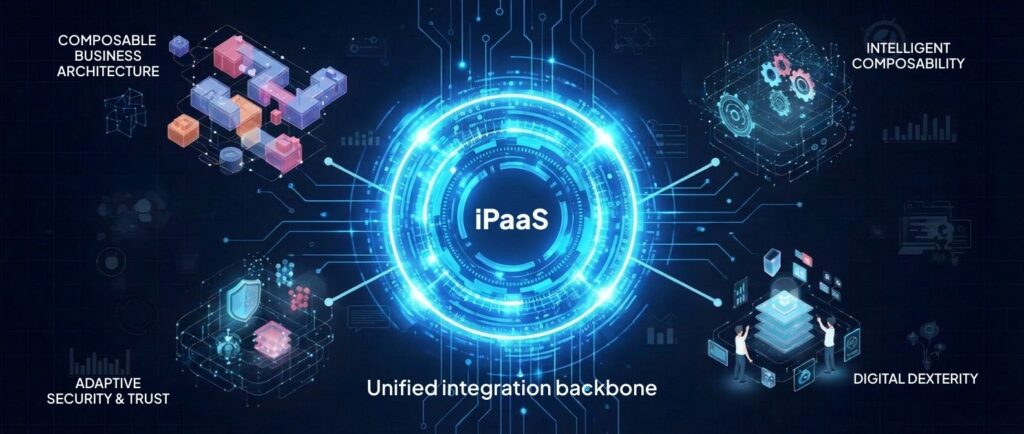
We have established the 23-point success gap, highlighted the common integration failure modes, and demonstrated how Boomi’s unified architecture directly addresses Gartner’s four Digital Vanguard Imperatives: Composable Architecture, Intelligent Composability, Adaptive Security & Trust, and Digital Dexterity. We also showed the compelling Total Cost of Ownership (TCO) impact of moving to a unified platform.