
For the modern CIO, the promise of Artificial Intelligence is often overshadowed by an architectural reality. Unified integration has become essential as integration, once considered as background “IT plumbing,” has moved to the center of the boardroom table, thanks to AI. As enterprises race to deploy autonomous agents and Generative AI, they are discovering that the “digital backbone” of the organization is being stretched.
At the heart of this strain is a scaling challenge known as the N×M Integration Problem. In an era where organizations must connect a growing number of AI models (N) to a vast array of enterprise tools, legacy databases, and SaaS applications (M), the traditional approach of building bespoke, point-to-point connections is no longer viable. To scale AI securely and avoid a terminal state of “digital sprawl,” IT leaders must shift their strategy toward a unified, platform-centric architecture.
TL;DR for CIOs
Here is a strategic TL;DR tailored for busy CIOs:
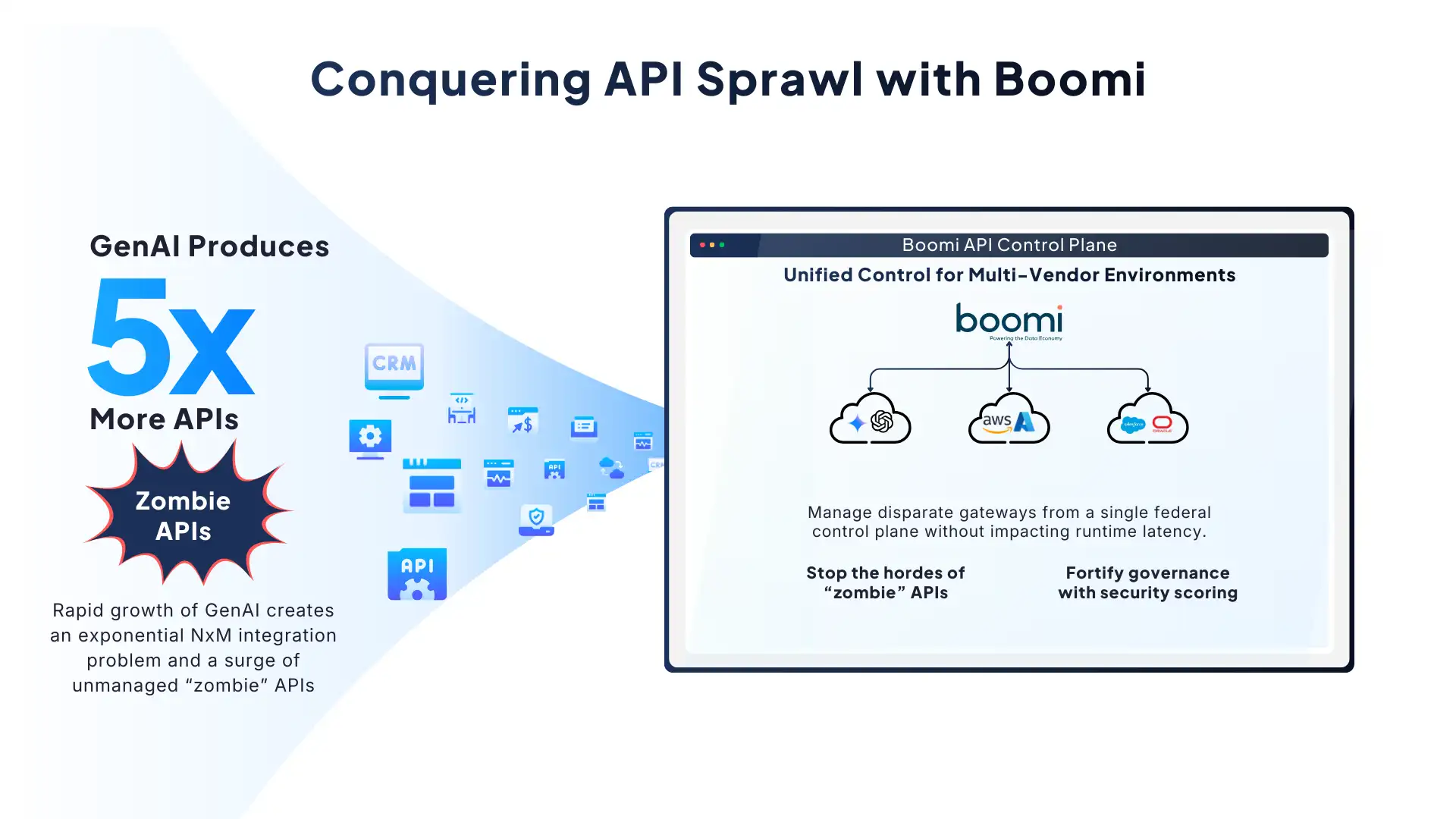
- As organizations adopt Generative AI, they produce five times more APIs, leading to an exponentially complex N×M integration problem and a proliferation of vulnerable, unmanaged zombie APIs.
- To solve this architectural complexity and replace brittle point-to-point connections, CIOs must transition to a unified Integration Platform as a Service (iPaaS) like the Boomi Enterprise Platform.
- Boomi’s API Control Plane actively mitigates the security risks of this digital sprawl by scanning your infrastructure to discover all deployed endpoints and bringing them under strict, centralized IT governance.
- Furthermore, Boomi’s support for the Model Context Protocol (MCP) provides a universal, standardized interface that allows AI agents to securely access enterprise data without requiring custom-built adapters or integrations.
The Hidden Cost of AI Innovation: The N×M Trap
The acceleration of AI innovation is creating a paradox: the more “intelligent” our applications become, the more fragmented our infrastructure appears. According to IDC, organizations with GenAI-enhanced applications in production are managing roughly five times more APIs than those not yet investing significantly in the technology.
This explosion of connectivity leads directly into the N×M trap. If your organization utilizes five different AI models and needs them to interact with twenty distinct internal systems, a point-to-point approach requires 100 unique adapters. This exponential complexity—”spaghetti integration” at an enterprise scale—drains IT budgets, creates massive technical debt, and leaves AI models trapped with outdated, static knowledge.
At RESKOM, we’ve seen that the only way to escape this trap is by establishing a structured integration operating model early. By utilizing reusable architectural patterns and a centralized platform, CIOs can transform exponential complexity into linear, manageable growth.
The Security Threat of "Zombie APIs"
In the rush to deliver AI-driven value, speed often comes at the expense of hygiene. Ad-hoc development frequently results in “Shadow IT” and the proliferation of Zombie APIs—abandoned, outdated, or undocumented endpoints that remain live in production.
Gartner estimates that APIs will soon represent the majority of the attack surface for 90% of web-enabled applications. In an AI-driven environment, these unmanaged endpoints are more than just a maintenance headache; they are a critical vulnerability. Malicious bots and automated actors can scan for these “zombie” entry points to exfiltrate sensitive enterprise data.
Exposing data to AI requires more than just a connection; it requires rigorous, enterprise-grade governance. This is why RESKOM prioritizes a security-first approach. With ISO 27001 and SOC 2 Type 2 certifications, we ensure that your API ecosystem is designed with audited operational controls, keeping data integrity at the forefront of every integration.
Platformization: Taming Chaos with Boomi’s API Control Plane
To combat sprawl and eliminate the zombie API problem, CIOs are moving away from monolithic middleware toward a unified Integration Platform as a Service (iPaaS). The Boomi Enterprise Platform, specifically its API Control Plane, provides the “single pane of glass” visibility that modern IT environments require.
The Boomi API Control Plane acts as a central registry, scanning an organization’s entire infrastructure to discover all deployed APIs, regardless of which gateway they reside behind. It brings these endpoints back under the governance of IT, assigning security and quality scores to each. This visibility allows CIOs to consolidate and retire legacy platforms, transforming a chaotic web of connections into a secure catalog of governed API products.
Future-Proofing with Universal Standards: MCP and Agentic AI
The permanent solution to the N×M problem lies in the adoption of open standards like the Model Context Protocol (MCP). MCP acts as a universal “nervous system,” allowing any AI model to seamlessly “plug and play” with any compliant enterprise tool.
Boomi’s native support for MCP and its Agentstudio allows enterprises to deliver “agent-ready” tools. By providing a universal interface, Boomi effectively turns the N×M burden into an N+M architecture. This ensures that AI agents can securely access live, real-time enterprise data without requiring a custom-built connection for every new model or tool added to the stack.
However, the primary barrier to this “agentic” future is often the legacy systems of the past. Transitioning from outdated middleware, such as MuleSoft, to a modern Boomi architecture is a high-stakes move. This is why we developed Renova—RESKOM’s modernization-led migration framework. Renova allows enterprises to migrate to Boomi with architectural integrity and zero downtime.
Conclusion: The Strategic Integration Mandate
In 2026 and beyond, integration is the operating system of the enterprise. To thrive in the AI era, CIOs must treat integration as a strategic capability rather than a tactical necessity. Solving the N×M problem and securing the API attack surface requires a unified, hybrid-ready platform that enforces governance at scale.
Don’t let digital sprawl hold back your AI transformation. Partner with RESKOM to modernize your digital backbone. With over 80 certifications across Boomi, Azure, and AWS, and a proven track record of enterprise-grade delivery, our architects can help you build a secure, AI-ready ecosystem.
Contact RESKOM today to explore an integration assessment or a tailored migration roadmap for your organization.
FAQs
What is unified integration in enterprise IT?
Unified integration is an architecture that connects applications, data, APIs, and AI systems through a centralized integration platform, reducing complexity and improving governance across enterprise environments.
How does unified integration solve the N×M integration problem?
Unified integration replaces multiple point-to-point connections with a centralized platform. Instead of building separate integrations for every system and AI model, organizations create reusable connections that scale efficiently.
Why is the N×M integration problem a challenge for CIOs?
As organizations adopt AI and multiple SaaS tools, the number of integrations grows exponentially. Managing these connections increases technical debt, security risks, and operational costs.
How does Boomi support unified integration?
The Boomi Enterprise Platform provides an integration platform as a service (iPaaS) that connects applications, data, APIs, and AI models with centralized governance and automation.
What are zombie APIs and why should enterprises eliminate them?
Zombie APIs are outdated or undocumented APIs that remain active in production. They create security vulnerabilities and increase the attack surface for enterprise systems.
How can organizations implement unified integration successfully?
Organizations can adopt unified integration by implementing an iPaaS platform, standardizing APIs, enabling centralized governance, and modernizing legacy systems with expert integration partners like RESKOM.