

Enterprise technology is at a turning point.
Not a gradual upgrade – a structural shift.
For the last decade, organizations optimized for the App Economy: humans clicking through SaaS tools, integrations stitched together with deterministic, rule-based logic. That model worked – until AI agents entered the picture.
We are now moving into what Boomi and industry leaders call the Agent Economy: a world where autonomous software agents reason, plan, and act across enterprise systems with minimal human intervention.
And here’s the uncomfortable truth: Most integration architectures aren’t ready for this shift.
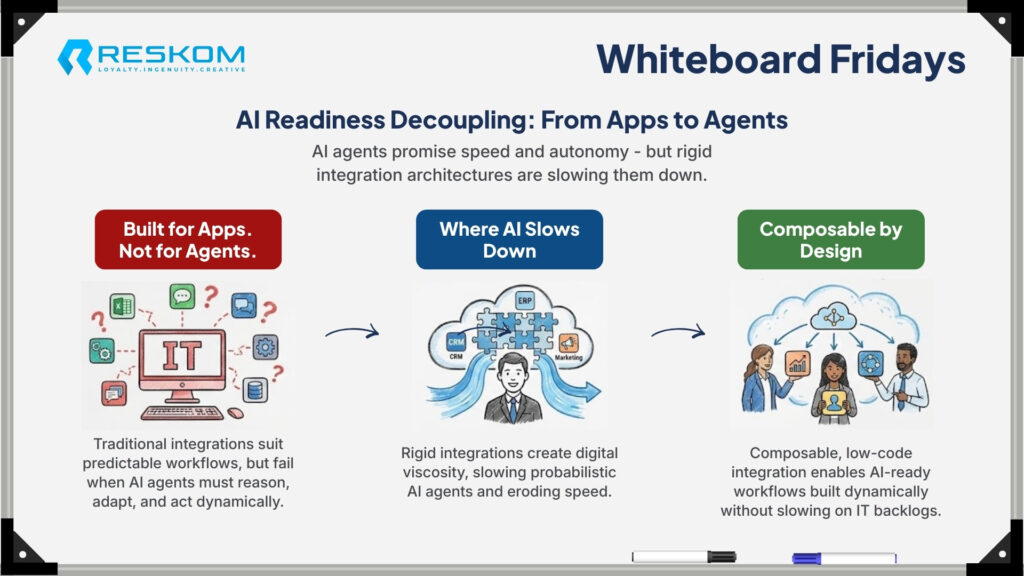
Why AI Agents Break Traditional Integration Models
Traditional integration platforms were built for predictability.
If X happens, do Y.
If the schema changes, fail the process.
If a new system is needed, open a ticket.
That deterministic approach collapses in an agentic world.
AI agents are probabilistic. They explore context, decide next steps dynamically, and often discover new data needs mid-workflow. When every new requirement triggers weeks of API refactoring, the promise of AI speed evaporates.
This friction is often described as “digital viscosity” – the drag created by rigid, code-heavy platforms that slow down innovation exactly when speed matters most.
This is where the integration model itself needs to change.
Platforms like Boomi take a different approach: instead of hard-coding every interaction, they expose integrations as configurable, reusable building blocks. New systems don’t require fresh code. Schema changes don’t break everything downstream. And integrations can evolve as agents learn and adapt.
In short: Your AI may be intelligent – but without a flexible, composable integration layer, it’s still running with the brakes on.
Decoding the Enterprise: The Shift to Composable Intelligence
The architectural answer to this problem is composability.
Instead of monolithic integrations and tightly coupled APIs, composable systems expose data, logic, and processes as modular building blocks. These blocks can be assembled — and reassembled – on demand.
This is where platforms like Boomi come into play. Boomi is designed around this composable model, treating integrations, connectors, and processes as reusable components rather than hard-wired code. As systems change, these components can be reconfigured instead of rewritten.
Why this matters for AI: AI agents are composable by nature. They combine reasoning, planning, and action dynamically. If the underlying integration layer isn’t equally flexible, agents can’t operate effectively – no matter how advanced the model is.
Research consistently shows that composable enterprises launch new capabilities dramatically faster than traditional ones – a gap that becomes existential in an AI-driven environment. A composable integration layer ensures AI innovation isn’t slowed down by rigid infrastructure.
Low-Code Is Not About Simplicity - It’s About Speed
A key theme in the document is the low-code vs. code-centric divide.
Code-heavy platforms promise control, but that control comes with a cost:
- Specialized talent
- Longer delivery cycles
- Centralized bottlenecks
Low-code platforms like Boomi abstract the plumbing. This doesn’t remove rigor – it removes unnecessary friction.
Crucially, low-code environments are also more AI-compatible. It’s far easier for an AI agent to configure a visual process or invoke a standardized connector than to generate, debug, and maintain complex Java or proprietary scripting logic.
This is how integration stops being a specialist-only activity and becomes an enterprise capability.
Governance Without Slowing the Business
One fear consistently surfaces: “If we democratize integration, do we lose control?”
The document is clear: governance must evolve, not disappear.
Boomi’s approach embeds governance directly into the platform – through centralized visibility, auditability, and policy enforcement across both integrations and AI agents.
This is especially critical as organizations face agent sprawl – hundreds or thousands of AI agents operating across systems. Without a control plane, observability collapses.
The takeaway:
Agility and governance are not opposites. They are design choices.
Where RESKOM Can Help
Technology alone doesn’t solve this shift. Execution does.
This is where RESKOM’s role becomes critical. The document highlights that real-world AI and integration success depends on:
- Runtime optimization
- Custom connector strategy
- Observability and document tracking
- Controlled rollout of agentic workflows
RESKOM’s Renova framework accelerates this transition by modernizing legacy, code-heavy integrations (including MuleSoft) into composable, Boomi-native architectures – reducing migration risk while unlocking AI readiness.
What Next?
The question is no longer: “Do we want AI agents?”
It’s: “Is our integration architecture flexible enough to let them work?”
The Agent Economy rewards organizations that remove friction, embrace composability, and treat integration as a strategic capability – not just plumbing.
And that shift needs to happen now.
Want to explore whether your business is ready for this shift? Reach out to Most Trusted Boomi Implementation Partner RESKOM – we’ll walk you through it.