
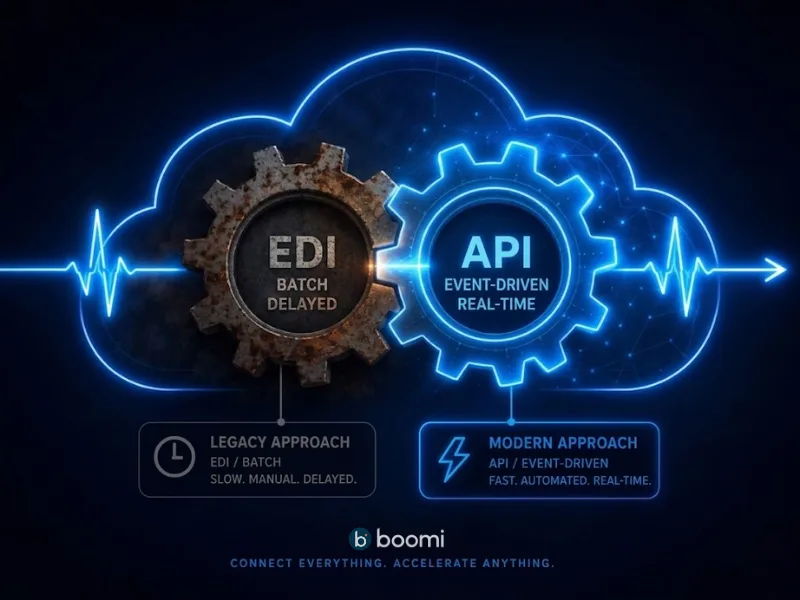
For decades, Electronic Data Interchange (EDI) has been the quiet workhorse of the enterprise. Operating behind the scenes, it has reliably driven supply chains, managed retail ecosystems, and processed millions of manufacturing transactions. As a foundational component of B2B Integration, EDI has enabled organizations to exchange critical business documents efficiently and at scale. But as businesses accelerate their digital transformation initiatives, CIOs and IT leaders are encountering a glaring roadblock: traditional EDI was not built for the speed of modern digital business.
Legacy, batch-based, on-premise EDI translators often operate in a vacuum. They are rigid, difficult to scale, and disconnected from the real-time demands of today’s cloud-native applications and mobile channels. When a minor formatting mismatch can delay a multi-million-dollar shipment—and when IT teams spend weeks manually onboarding a single trading partner—it becomes clear that operating EDI in an isolated silo is no longer sustainable.
The solution is not to abandon EDI—standards like X12 and EDIFACT remain indispensable for global B2B commerce. Instead, the future of enterprise connectivity lies in a hybrid integration architecture where traditional EDI and real-time APIs seamlessly coexist.
By wrapping EDI workflows in modern APIs and leveraging a unified integration Platform as a Service (iPaaS) like Boomi, enterprises can achieve unprecedented agility, visibility, and governance.
Here is how IT leadership can architect this evolution.
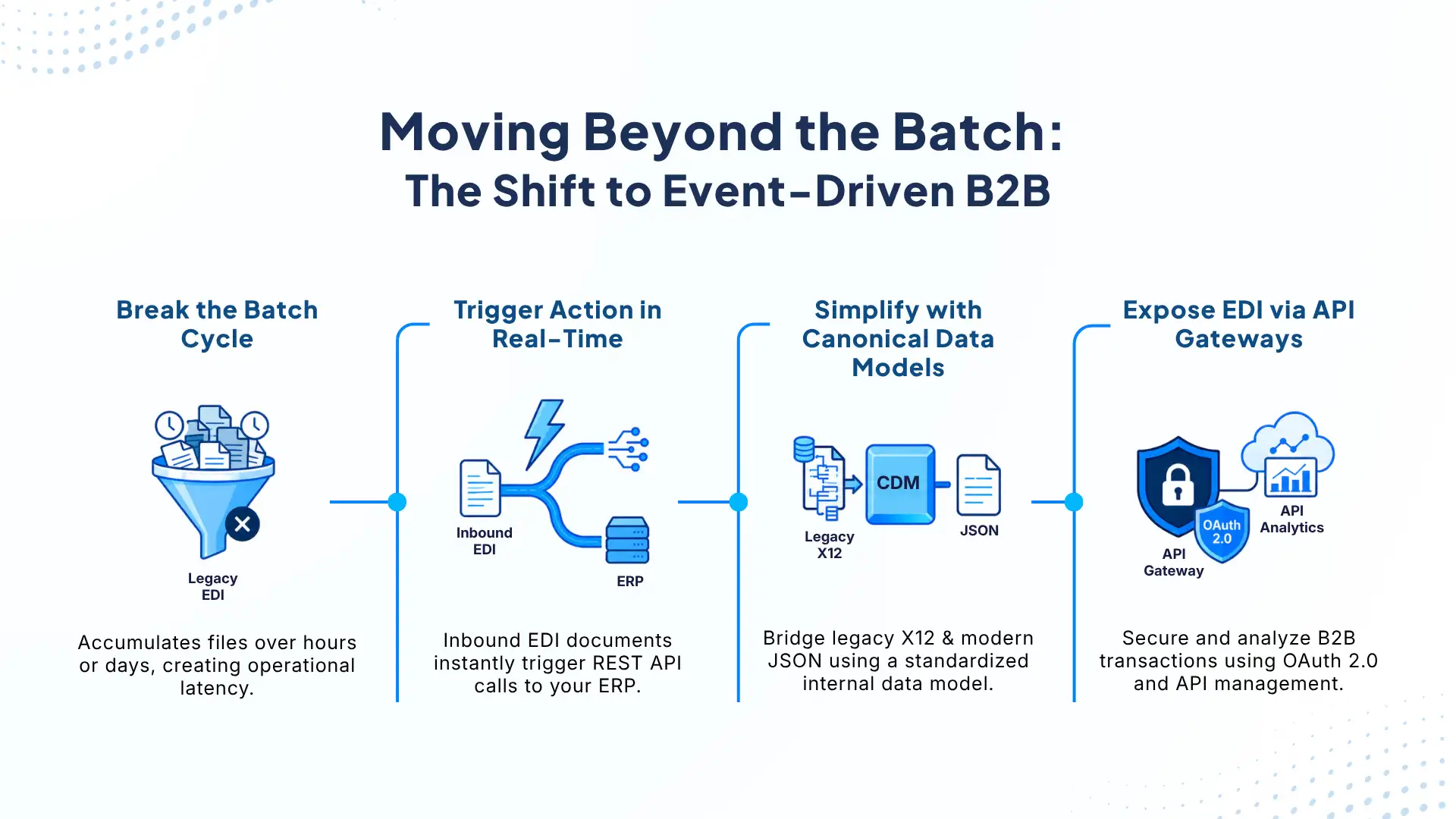
Moving Beyond the Batch: The Shift to Event-Driven B2B Integration
Historically, EDI has relied on batch processing—accumulating files over hours or days before transmitting them via Value-Added Networks (VANs). While functional, this latency is incompatible with today’s demands for real-time inventory visibility, instant order-to-cash cycles, and immediate payment processing.
In a hybrid EDI and API architecture, organizations transition from scheduled batches to event-driven triggers. By modernizing your B2B framework on a cloud-native platform like Boomi, an inbound EDI 850 (Purchase Order) can instantly trigger a REST API call to your ERP (such as SAP or NetSuite). This eliminates the “black box” of legacy EDI, transforming it into a transparent, real-time data flow that empowers business users with immediate operational insights.
Simplifying Complexity with a Canonical Data Model
One of the most significant challenges in hybrid architectures is data translation. When you have legacy systems speaking X12, mobile apps speaking JSON, and backend ERPs speaking proprietary XML, point-to-point mappings quickly devolve into an unmanageable “spaghetti” architecture.
The most effective strategy to overcome this is defining a Canonical Data Model (CDM).
A canonical model acts as a universal translator—a standardized internal data structure that both your EDI maps and API endpoints reference. Instead of mapping a partner’s specific X12 format directly to your ERP’s database schema, you map the incoming EDI document to your CDM. Your internal APIs then consume data exclusively from this canonical format.
This approach drastically simplifies transformation logic. If you replace your ERP or onboard a partner with a wildly different data structure, you only need to map the new endpoint to the CDM, leaving the rest of your architecture untouched. It promotes consistency, accelerates partner onboarding, and bridges the gap between old-school EDI and modern RESTful services.
Exposing EDI Transactions via API Gateways
In a mature hybrid architecture, EDI data doesn’t just flow—it is actively managed, secured, and monetized. By exposing traditional EDI transactions as APIs through an API Gateway, IT leaders can bring enterprise-grade governance to their B2B networks.
Imagine wrapping an EDI 856 (Advance Ship Notice) or an 810 (Invoice) in a secure REST API. Through Boomi API Management, you can apply OAuth 2.0 authentication, implement rate limiting, and gain deep analytics into transaction volumes. This allows you to offer self-service onboarding portals for trading partners, reducing IT dependency and accelerating time-to-value from weeks to hours.
Furthermore, applying API management to EDI bridges the gap between compliance and innovation, allowing internal developers to query EDI statuses (e.g., GET /edi/status/{id}) without needing specialized EDI expertise.
The RESKOM Advantage: Engineering Secure, Scalable Integrations
Transitioning to a hybrid EDI and API architecture is a complex undertaking that requires more than just a software license. It requires architectural rigor, deep platform expertise, and a commitment to security.
As a Boomi Platinum Partner, RESKOM specializes in helping enterprises modernize their digital backbone. We don’t just build integrations; we engineer long-term architectures.
Here is why enterprise CIOs partner with RESKOM for their modernization journeys:
- Architectural Excellence: We implement structured integration operating models, including Canonical Data Models and event-driven patterns, ensuring your Boomi environment is scalable, maintainable, and loosely coupled.
- Enterprise-Grade Security: Operating complex hybrid IT landscapes demands uncompromising security. RESKOM’s delivery methodologies are backed by ISO 27001 and SOC 2 Type 2 certifications, ensuring your data is handled with audited operational controls and stringent risk management.
- Proven Accelerators: We bring mature frameworks to every engagement—from automated CI/CD pipelines (Jenkins, Azure DevOps) to advanced exception handling and monitoring via ELK stacks.
Conclusion
The era of treating EDI as a standalone, back-office function is over. To compete in a real-time digital economy, enterprises must integrate their B2B ecosystems with their modern application landscapes. By embracing a hybrid EDI and API architecture on Boomi, IT leaders can break down data silos, enforce robust governance, and turn their supply chain into a competitive advantage.
Ready to modernize your EDI backbone?
Let’s discuss your integration architecture. Reach out to explore how RESKOM can help you design and implement a unified EDI strategy.
Connect with RESKOM’s certified integration experts today to learn how we can bring total transparency, automated reconciliation, and executive-level visibility to your enterprise EDI architecture.
FAQs
What is B2B Integration?
B2B Integration is the process of connecting business systems, applications, and trading partners to automate the exchange of data, documents, and transactions across organizations.
Why is a hybrid EDI and API architecture important?
A hybrid architecture combines the reliability of EDI with the speed and flexibility of APIs, enabling real-time data exchange while maintaining compliance with industry standards.
How do APIs enhance traditional EDI processes?
APIs provide real-time connectivity, faster transaction processing, improved visibility, and easier integration with cloud applications, ERPs, and mobile platforms.
What is a Canonical Data Model (CDM) in B2B Integration?
A Canonical Data Model is a standardized data structure that acts as a common format between EDI documents, APIs, and business applications, simplifying data transformations and integrations.
How does Boomi support B2B Integration?
Boomi provides a cloud-native integration platform that enables organizations to connect EDI systems, APIs, applications, and trading partners through a unified integration environment.
What are the key benefits of modernizing B2B Integration with EDI and APIs?
Organizations gain real-time visibility, faster partner onboarding, improved scalability, stronger governance, enhanced security, and reduced operational complexity.