

In today’s hyper-connected supply chains, Electronic Data Interchange (EDI) is the lifeblood of B2B commerce. However, as transaction volumes surge and trading partner networks expand globally, poorly architected EDI ecosystems quickly become operational bottlenecks. Every new partner onboarding becomes a heavy lift, and every minor error results in hours of manual troubleshooting.
While modern cloud-native iPaaS solutions like Boomi provide powerful B2B/EDI management capabilities, software alone does not guarantee scale. To truly future-proof your B2B ecosystem, IT leaders must prioritize architectural rigor.
Based on RESKOM’s experience engineering enterprise-grade integrations, here are the foundational design principles and best practices for building scalable, reliable, and easily maintainable Boomi EDI workflows.
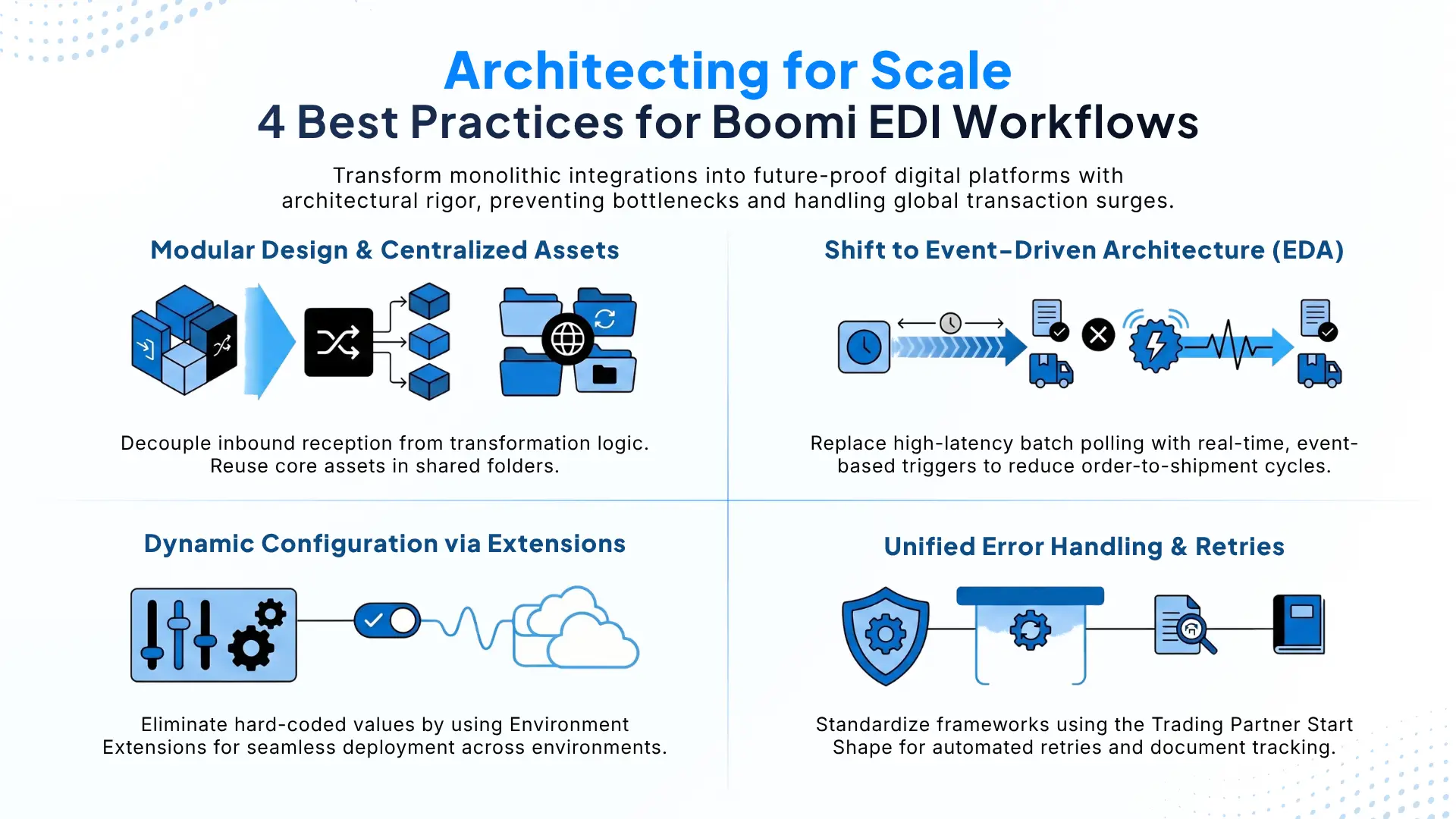
1. Embrace Modular Process Design and Centralized Components in Boomi EDI Workflows
One of the most common pitfalls in EDI implementation is creating monolithic, partner-specific processes. When transformation logic, validation, and routing are all hard-coded into a single massive canvas, maintaining the architecture becomes a nightmare.
Best Practice:
Break down your integration processes into smaller, modular, and loosely coupled components. Decouple the inbound document reception (the Trading Partner Start Shape) from the backend system routing and transformation logic.
Crucially, organizations must centralize shared components. XML/JSON profiles, EDI profiles, canonical data maps, and cross-reference tables should reside in centralized “Shared Folders” within your Boomi account. By reusing these core assets, you ensure data consistency across your entire B2B network. When it comes time to onboard your fiftieth trading partner, you are simply plugging them into an existing, proven architecture rather than building from scratch.
2. Dynamic Configuration via Environment Extensions
A hallmark of a mature integration architecture is the complete elimination of hard-coded values. An EDI process must be able to move from Development to QA, and finally to Production, without requiring developers to open the canvas and alter connection parameters.
Best Practice:
Leverage Boomi Environment Extensions extensively. Any variable that changes based on the environment or the specific trading partner—such as AS2 certificates, SFTP hostnames, API endpoints, and dynamic process properties—must be extended.
By defining Trading Partner properties through extensions, your IT team can seamlessly deploy standard templates across environments. This not only mitigates the risk of deploying incorrect credentials to production but also aligns perfectly with modern Continuous Integration and Continuous Deployment (CI/CD) pipelines, enabling automated, zero-touch deployments.
3. Shift Toward Event-Driven Architectures (EDA)
Traditional EDI relies heavily on scheduled batch processing—polling a VAN or an FTP server every few hours. In a digital economy where customers expect instant inventory updates and next-day shipping, batch processing introduces unacceptable latency.
Best Practice:
Transition from batch polling to event-driven architectures wherever possible. Utilize Boomi’s event-based triggers, message queuing, or integrations with event brokers like Kafka or AWS EventBridge.
By designing components to react asynchronously to incoming events (e.g., an inbound 850 Purchase Order instantly triggering an inventory validation check via API), enterprises can drastically reduce order-to-shipment cycles. Loosely coupled, event-driven integrations ensure that backend systems are not overwhelmed by massive batch loads, improving overall system resilience.
4. Implement Unified Error Handling and Retry Mechanisms
In B2B integration, failures are inevitable. Network timeouts occur, trading partners send malformed data, and backend APIs experience downtime. A scalable EDI architecture must handle these exceptions gracefully without requiring manual IT intervention for every error.
Best Practice:
Standardize your error handling frameworks. First, always use the Trading Partner Start Shape for inbound EDI. This shape natively tracks document execution and uniquely enables failed documents to be rerun directly from Boomi’s Process Reporting UI—a massive time-saver for support teams.
Second, capture and persist critical identifiers (such as ISA, GS, and ST control numbers, or PO numbers) as tracked fields. This allows business users to search for specific transactions easily. Finally, route all process exceptions through a centralized error-handling sub-process that logs the failure, triggers intelligent alerts to the right stakeholders, and, when applicable, initiates an automated retry mechanism with exponential backoff.
The RESKOM Advantage: Engineering with Enterprise Governance
Designing an EDI architecture that handles millions of monthly transactions requires more than just technical know-how; it requires an established Integration Operating Model.
As a Boomi Platinum Partner, RESKOM brings deep architectural expertise to complex B2B ecosystems. We do not just build integrations—we engineer robust digital platforms. Our delivery teams leverage standardized design patterns, reusable templates, and proprietary accelerators to drastically reduce partner onboarding times and ensure delivery predictability.
Furthermore, enterprise connectivity demands uncompromising security. RESKOM’s operations are backed by ISO 27001 and SOC 2 Type 2 certifications. When we design your Boomi B2B architecture, you are guaranteed mature information security management, audited controls, and operational discipline suitable for the most heavily regulated global enterprises.
Ready to modernize your EDI backbone?
Let’s discuss your integration architecture. Reach out to explore how RESKOM can help you design and implement a unified EDI strategy.
Connect with RESKOM’s certified integration experts today to learn how we can bring total transparency, automated reconciliation, and executive-level visibility to your enterprise EDI architecture.
FAQs
What are Boomi EDI Workflows?
Boomi EDI Workflows are automated integration processes built on the Boomi platform to manage Electronic Data Interchange (EDI) transactions between trading partners and enterprise systems.
Why is modular design important in Boomi EDI Workflows?
Modular design improves scalability, simplifies maintenance, accelerates partner onboarding, and enables reusable integration components across multiple workflows.
How do Environment Extensions improve EDI integrations?
Environment Extensions eliminate hard-coded values by dynamically managing credentials, endpoints, certificates, and configurations across Development, QA, and Production environments.
What is the role of Event-Driven Architecture in EDI?
Event-Driven Architecture (EDA) enables real-time processing of EDI transactions, reducing latency and improving responsiveness across supply chain operations.
How can businesses improve error handling in Boomi EDI Workflows?
Businesses can implement centralized error-handling frameworks, automated retries, tracked transaction identifiers, and intelligent alert systems to reduce downtime and manual intervention.
Why choose RESKOM for enterprise EDI architecture?
RESKOM provides enterprise-grade integration expertise, reusable accelerators, governance frameworks, and secure delivery backed by ISO 27001 and SOC 2 Type 2 standards.