

In our work delivering integrations for enterprise clients across retail, pharma, and manufacturing, we observe a recurring theme. Organizations invest heavily in hardening their Salesforce instances—implementing Shield encryption, intricate permission sets, and MFA—yet often overlook Boomi Salesforce Integration Security and the governance of the integration layer itself.
The “pipe” connecting Salesforce to your ERP or Data Lake is not passive infrastructure; it is an active participant in your data architecture with read/write access to critical commercial information. When we architect solutions, we look at the entire data lifecycle with a holistic approach. To truly secure the enterprise, CIOs need a governance checklist that looks beyond the endpoints to validate the operational maturity of the entire integration supply chain.
At RESKOM, we operate with a singular focus: ensuring our customers get the best out of Boomi. In this blog, we take you through the best practices that can help secure your Boomi integrations.
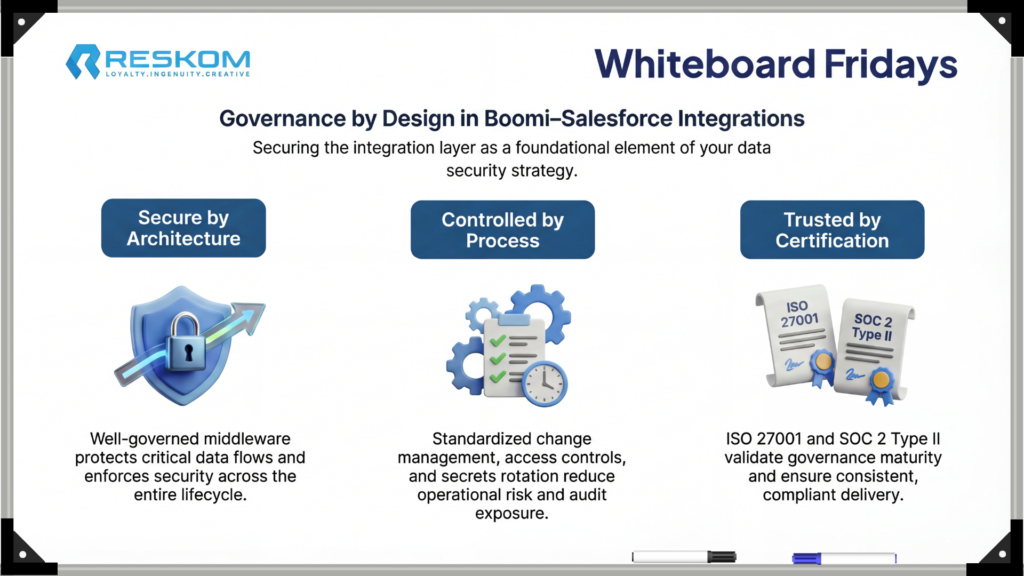
The Role of Middleware in Data Security
Common Boomi-Salesforce Integration Pitfalls
Cloud security operates on a Shared Responsibility Model. Salesforce secures the SaaS application, and Boomi secures the PaaS infrastructure (The Boomi Enterprise Platform). However, the configuration of the integration logic, API key management, and data handling processes fall to the customer and their System Integrator (SI).
As a CIO, this middleware layer is critical to your data security. In the context of Boomi Salesforce Integration Security, an integration process typically requires an “Integration User” profile in Salesforce with specific access rights. Ensuring this user and the processes it powers are governed with the same rigor as your internal teams is essential for maintaining a seamless, compliant data environment.
Security gaps in the integration space rarely stem from the Boomi platform itself. Instead, they usually arise from implementation choices that haven’t fully leveraged the platform’s security features.
In our audits of existing integrations, we help clients optimize three specific areas:
- Secrets Management Hygiene: We often see API tokens and OAuth credentials stored directly within Boomi maps. The best practice is to abstract these via Environment Extensions, allowing credentials to be rotated and managed without touching the underlying code. Beyond basic OAuth, the gold standard for Boomi-Salesforce security is the JWT Bearer Token Flow. This eliminates the need for manual token refreshes and minimizes the risk of credential exposure during the handshake proces
- Privilege Management: During the build phase, developers may require broad access. A common oversight is failing to restrict these privileges post-deployment. We advocate for a “Least Privilege” model, ensuring the Integration User has only the permissions strictly necessary for the interface to function. We assist clients in configuring a dedicated Salesforce Integration Profile that restricts the Boomi Atom’s visibility to only the specific objects and fields required for the business logic, preventing lateral movement in the event of a breach.
- Data Handling & Logging: It is important to configure Process Reporting logs correctly. We ensure that payloads—especially those containing PII—are not written to logs during standard operations, keeping your data ephemeral and secure.
Boomi’s Native Security Framework
Boomi provides a robust security architecture to address these needs. The key is having an architect who knows how to configure them for your specific compliance requirements.
- AtomSphere Architecture: Boomi’s separation of the Control Plane (metadata) from the Data Plane (runtime) is a powerful asset. When architected correctly using local Atoms, your customer data never has to transit the Boomi cloud; it can move directly from Salesforce to your on-premise ERP behind your firewall.
- Identity Federation: Support for SAML 2.0 allows for centralized identity management, ensuring that access to the integration platform mirrors your corporate directory policies.
- PGP & X.509: Native support for standard encryption protocols ensures data is protected according to industry standards during transit.
The RESKOM Governance Model: Operationalizing ISO 27001 & SOC 2 Type II
Many partners follow good security practices, but certifications provide external validation of that maturity. At RESKOM, our ISO 27001 and SOC 2 Type II certifications serve as the framework for how we deliver your projects.
ISO 27001: The Management Framework
This certification validates our Information Security Management System (ISMS). It ensures that security is a managed, continuous process. It guarantees that every RESKOM consultant operates within a structured environment regarding asset management and access control.
SOC 2 Type II: The Operational Proof
While a SOC 2 Type I report validates that controls are designed correctly, our Type II certification proves operational effectiveness over time.
It provides you with assurance that:
- Change Management protocols are consistently followed for every deployment.
- Logical Access to client environments is restricted and reviewed periodically.
- Incident Response plans are established and tested.
When we integrate your Salesforce environment, we apply these rigorous operational standards to ensure your data is handled with the same care you expect from your own internal teams. Our SOC 2 Type II status ensures that every deployment we perform on your Boomi platform follows a documented Change Management workflow. This prevents unauthorized ‘hot-fixes’ in production and ensures a permanent, auditable trail of who moved what code and when.
CIO’s Guide to Validating Partner Governance
If you are evaluating a partner to handle your Boomi-Salesforce integration, assessing their governance maturity is just as important as assessing their technical skills.
Here is a checklist to guide your partner discussions:
- Verify the “Level”: A SOC 2 Type I report is a good start, but a Type II report demonstrates consistent adherence to controls over a period of 6-12 months.
- ISO 27001 Validation: Confirm the partner operates under a formal Information Security Management System (ISMS). This signifies that security is a continuous, managed discipline involving regular risk assessments, rather than just ad-hoc IT controls.
- Secrets Rotation: Ask about their approach to managing Salesforce OAuth tokens within Boomi. Look for partners who prioritize Environment Extensions and automated rotation policies.
- Scope of Audit: Ensure their certification specifically covers their Professional Services / Implementation Practice.
Environment Strategy: Discuss how they separate development data from production data to ensure data privacy throughout the lifecycle.
Conclusion
Integration is the central nervous system of your enterprise, connecting every critical application you own. It deserves the same governance standards as the core applications it supports.
By selecting a partner that mirrors your own compliance standards—with the proven audit trail of ISO 27001 and SOC 2 Type II—you ensure that your connectivity strategy is built on a foundation of trust and operational excellence.
Is your integration architecture optimized for security and governance?
Reach out to RESKOM for a Boomi Platform Optimization of your existing Boomi environment. Let’s ensure your middleware is as robust as your endpoints.