

In today’s fast-paced market, businesses can’t afford to wait months for new system integrations. Boomi notes that modern enterprises need connections in days or even hours, not weeks or months. When centralized IT teams move too slowly, lines-of-business often create their own “shadow IT” workarounds to get what they need. These unofficial fixes lead to data silos, security risks and inefficiency. In this blog, we walk you through how an integration platform like Boomi can democratize connectivity by giving business users the tools to connect applications themselves (with IT oversight) so the whole company can move at the speed of opportunity.
The "Shadow IT" Problem
Why business units buy their own tools when IT moves too slowly - and how to fix it
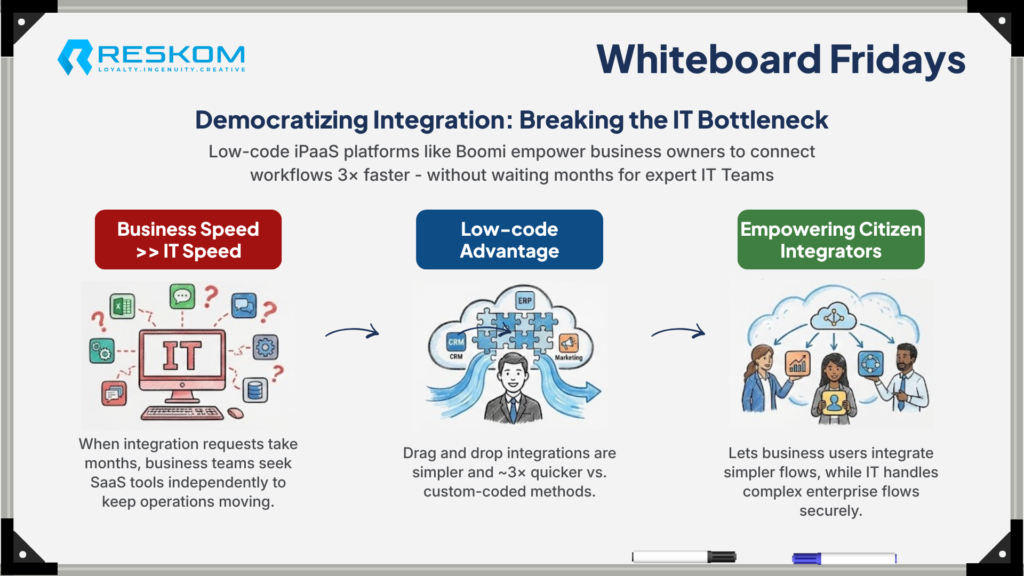
When IT is backlogged, departments often bypass it and procure their own solutions. We hear this often when we interact with clients, “shadow IT crept in, with lines of business going straight to a self-service public cloud to avoid dealing with long waits for provisioning from overburdened IT teams”. This happens because business users simply need faster results than traditional IT cycles allow. The fix is to give those teams legitimate self-service options under proper governance. Boomi allows non-technical users to build and deploy simple data flows on their own, while still enforcing security and best practices. In other words, instead of experimenting with ad-hoc solutions, teams use a comprehensive and holistic low-code tool – eliminating the root causes of shadow IT and keeping data flowing safely across the enterprise.
Low-Code vs. Heavy Code
How Boomi allows business analysts to handle simple flows while IT governs the complex ones
A visual, low-code interface can supercharge integration speed. Boomi provides a canvas and hundreds of pre-built connectors so users can simply drag, drop and configure – rather than write Java/Maven code from scratch. In practice this approach slashes development time. For instance, drag-and-drop workflows can cut manual coding by about 80%, integration rollout can be up to 70% quicker, cutting waste and enabling innovation cycles 3× faster. In short, what might take weeks or months with a code-heavy tool can often be done in days with Boomi. This rapid time-to-value is a key reason enterprises choose Boomi over traditional integration stacks.
Empowering the "Citizen Integrator"
Why dragging-and-dropping a connector is 3x faster than writing Maven dependencies
Boomi is built for both developers and non-developers. It “empowers the ‘citizen integrator’ revolution” by putting integration power into the hands of analysts, salespeople and other domain experts. In practice, routine flows (like syncing a CRM to an email tool, or connecting two cloud apps) can be built by business users with minimal training. Meanwhile, IT focuses on the hard architectural problems. Boomi meets the needs of developers and citizen integrators alike – Boomi supports both citizen integrators and professional developers—offering simple no-code and low-code experiences for business users, while providing full-code control and extensibility for IT and integration specialists. This means business teams can get the data they need themselves – improving agility – while IT still retains governance over the platform.
Governance with Built-In Guardrails
How to maintain security while giving business teams the agility they crave
A common concern is that self-service might compromise security. Boomi addresses this by embedding governance into the platform. Every change is tracked and auditable, and all integrations run through a controlled runtime. As Boomi observes, business users can resolve most issues themselves while IT “isn’t worried about security concerns because of the inherent governance of the Boomi platform”. In practice, clear oversight is maintained even as users self-build: Boomi dashboards show who changed what and when, and governance policies ensure only authorized connectors and data flows are used. In short, Boomi gives teams agility and compliance – letting them innovate rapidly without throwing away safety.
While low-code platforms like Boomi enable business teams to build new integrations faster, many organizations still struggle with a large backlog of existing, code-heavy integrations. Addressing this backlog is critical to fully realizing the promise of democratized integration.
How We at RESKOM Help Reduce Integration Delivery Time from Weeks to Days
Why we advise clients to choose platforms that treat connectors as a Service
Real-world results demonstrate the difference. Once business teams can build their own integrations, delivery times reduce. At RESKOM, we help organizations reduce integration delivery timelines from weeks to days by combining Boomi’s low-code platform with purpose-built accelerators. Our AI-powered MuleSoft-to-Boomi migration framework, Renova, directly addresses one of the biggest barriers to democratized integration: the IT backlog of complex, code-heavy integrations.
By automating up to 50% of MuleSoft-to-Boomi conversion tasks, Renova frees IT teams from manual rework, accelerates the transition to Boomi, and enables business users to start building and owning integrations sooner—without waiting for IT-led migration projects to complete – a true democratization of integration. To know more, contact us today.