

One of the most persistent frustrations in traditional B2B commerce is the “black box” of legacy EDI. When a critical Purchase Order (850) is transmitted to a supplier, or an Invoice (810) is sent to a retailer, business stakeholders invariably ask: “Did it go through?” In a legacy environment, answering that simple question often requires an integration developer to pause their strategic work, dig through cryptic server logs, and manually decipher raw X12 or EDIFACT segments. This lack of EDI visibility not only drains IT resources but also causes blind spots in the supply chain, leading to delayed shipments, uncollected revenue, and strained partner relationships.
Modernizing your B2B architecture on a cloud-native platform like Boomi illuminates this black box. By architecting intelligent tracking workflows and deploying human-readable dashboards, IT leaders can provide end-to-end operational transparency. Here is how to demystify EDI visibility for the modern enterprise.
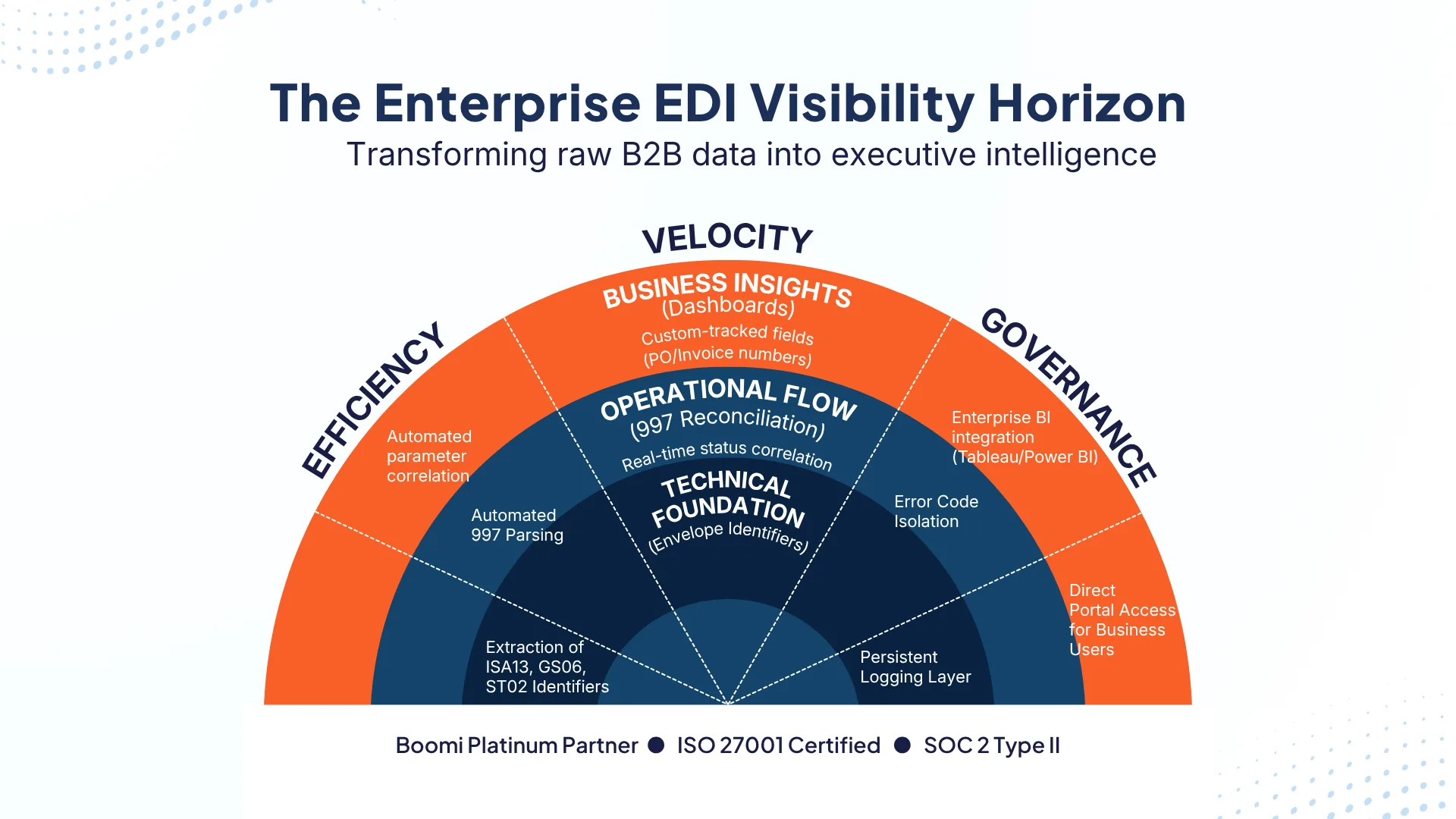
The Core Challenge: Making EDI Human-Readable
EDI standards were designed for machine-to-machine communication, not human comprehension. When a partner receives an EDI document, standard protocol dictates they return a 997 Functional Acknowledgment. The 997 simply states whether the syntax of the previously sent document was accepted or rejected.
The problem is that the 997 does not explicitly name the document it is acknowledging (e.g., “PO #12345”). Instead, it references arbitrary control numbers generated during the transmission. To achieve true visibility, an integration platform must be able to seamlessly correlate those cryptic control numbers with meaningful business data.
This is where RESKOM’s EDI solution comes into play. It is a plug-and-play solution that fetches your EDI data from Boomi, and makes it human readable. It is highly customizable to your business needs, and gives a birds eye view of your entire EDI data. Reach out to our team for a live demo.
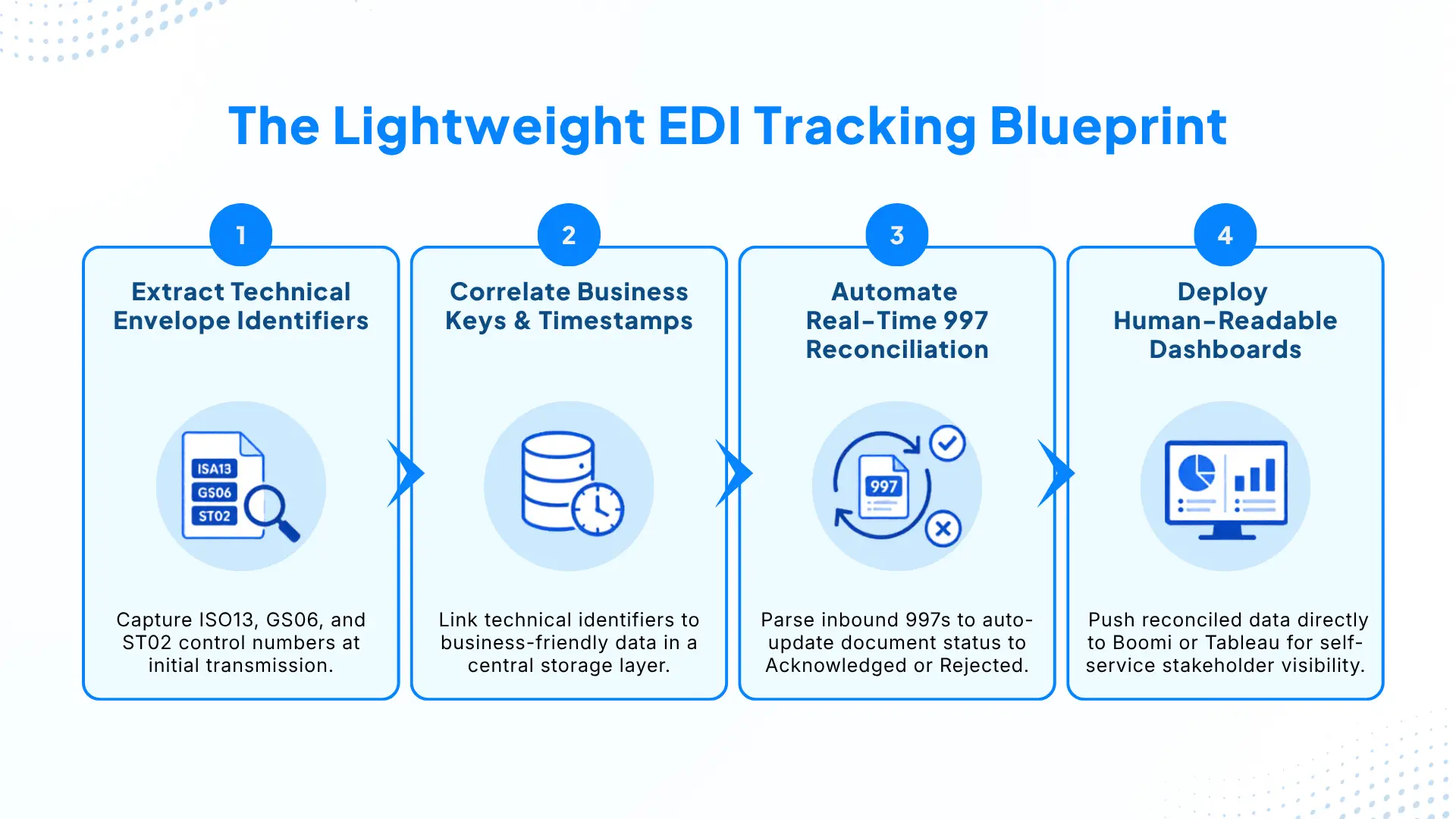
Architecting a Lightweight Tracking Engine
To bridge the gap between raw data and business intelligence, integration architects must build a centralized, lightweight tracking mechanism alongside their core EDI flows.
When an outbound document (like an 850) is generated in Boomi, the process should extract the unique EDI envelope identifiers—specifically the ISA13 (Interchange Control Number), GS06 (Group Control Number), and ST02 (Transaction Set Control Number).
Simultaneously, the process should extract the human-readable business key, such as the Purchase Order Number. These data points, along with a “Pending” status and a timestamp, are then pushed to a central persistence layer—whether that is a dedicated Audit Database, an Amazon S3 bucket, or a Boomi Atom Queue.
This simple architectural step lays the foundation for automated reconciliation.
Automating 997 Reconciliation
With the original outbound data securely logged, handling the inbound 997 Functional Acknowledgments becomes a highly automated process.
When a 997 arrives via the Boomi Trading Partner Start Shape, a dedicated sub-process is triggered. This process parses the AK1 and AK2 segments of the 997, which contain the exact GS and ST control numbers of the original transmission.
Boomi then queries the central tracking database using those control numbers, finds the exact Purchase Order it correlates to, and automatically updates the status from “Pending” to “Acknowledged” (or “Rejected,” capturing the specific error codes). This entire reconciliation cycle happens in real time, completely eliminating manual log chasing.
Empowering the Business with Boomi Portals
Data correlation is only valuable if the right people have access to it. IT should not be the gatekeeper of supply chain visibility.
By leveraging Boomi’s Trading Partner Reporting Portal, IT can grant authorized business users—such as supply chain managers and accounts receivable teams—direct access to transaction lifecycles. Users can bypass the underlying code and search for documents using custom tracked fields like “Customer Number” or “Invoice Number.”
For more advanced analytics, the central tracking database built during the correlation phase can be seamlessly connected to enterprise BI tools (like Tableau or PowerBI) or monitoring stacks (like ELK). This allows organizations to build real-time, human-readable dashboards displaying metrics such as “Invoices Awaiting Acknowledgment,” “Top Partner Error Rates,” and “Average Transaction Latency.”
The RESKOM Advantage: Enterprise-Grade Data Visibility
Providing comprehensive data visibility across a high-volume B2B ecosystem requires robust architecture and secure implementation.
As a Boomi Platinum Partner, RESKOM specializes in moving enterprises beyond basic system connectivity toward meaningful data visibility and analytics. We design and implement standardized tracking frameworks and error-handling mechanisms that provide real-time operational insights without degrading process performance.
Because we understand that transaction data is highly sensitive, RESKOM operates under rigorous ISO 27001 and SOC 2 Type 2 certifications. Whether we are integrating your EDI data into a secure AWS data lake or building custom operational dashboards in Azure, our delivery methodologies ensure your information is protected by audited controls and mature risk management protocols.
Ready to modernize your EDI visibility backbone?
Let’s discuss your integration architecture. Reach out to explore how RESKOM can help you design and implement a unified EDI strategy.
Connect with RESKOM’s certified integration experts today to learn how we can bring total transparency, automated reconciliation, and executive-level visibility to your enterprise EDI architecture.
FAQs
What is EDI visibility?
EDI visibility refers to the ability to track, monitor, and view the status of EDI transactions in real time, including purchase orders, invoices, and acknowledgments.
What is a 997 Functional Acknowledgment in EDI?
A 997 Functional Acknowledgment is an EDI document that confirms whether an EDI transaction was received and accepted or rejected based on syntax validation.
Why is 997 acknowledgment tracking important?
997 tracking helps businesses confirm successful EDI transmissions, reduce manual troubleshooting, avoid delays, and improve supply chain communication.
How does Boomi improve EDI visibility?
Boomi enables automated EDI tracking, real-time reconciliation, centralized monitoring, and dashboard integration for complete transaction visibility.
Can EDI dashboards show real-time transaction status?
Yes, modern EDI dashboards can display real-time statuses such as pending, acknowledged, rejected, and completed transactions for better operational monitoring.
How does RESKOM help with EDI visibility solutions?
RESKOM provides customizable EDI visibility solutions, automated 997 reconciliation, operational dashboards, and secure enterprise-grade integration services using Boomi.