

Introduction: The $40 Billion Data Infrastructure Opportunity
Enterprise investments of $30-40 billion in generative AI represent one of the most significant technology transformations in business history. Yet the real opportunity lies not in the AI models themselves, but in the foundational data infrastructure that enables measurable ROI. Organizations successfully deploying agentic AI systems—capable of autonomous reasoning and action—are discovering a powerful truth: when sophisticated AI models are paired with clean, connected data architectures, they unlock unprecedented business value.
At RESKOM, we observe a consistent pattern across industries: enterprises that invest in data integration and master data management before deploying AI agents achieve dramatically higher success rates. The root cause of success is straightforward: architectural excellence built through decades of strategic integration and unified data systems. As Lucidworks CEO Mike Sinoway aptly frames it: “Building cutting-edge applications atop strong foundations is like putting an F1 engine in an F1 car—both components must match for peak performance.”
This article explains how clean, connected data powers agentic AI success, introduces a three-pillar AI-readiness framework, and shows how RESKOM helps enterprises operationalize agentic AI using the Boomi Enterprise Platform.
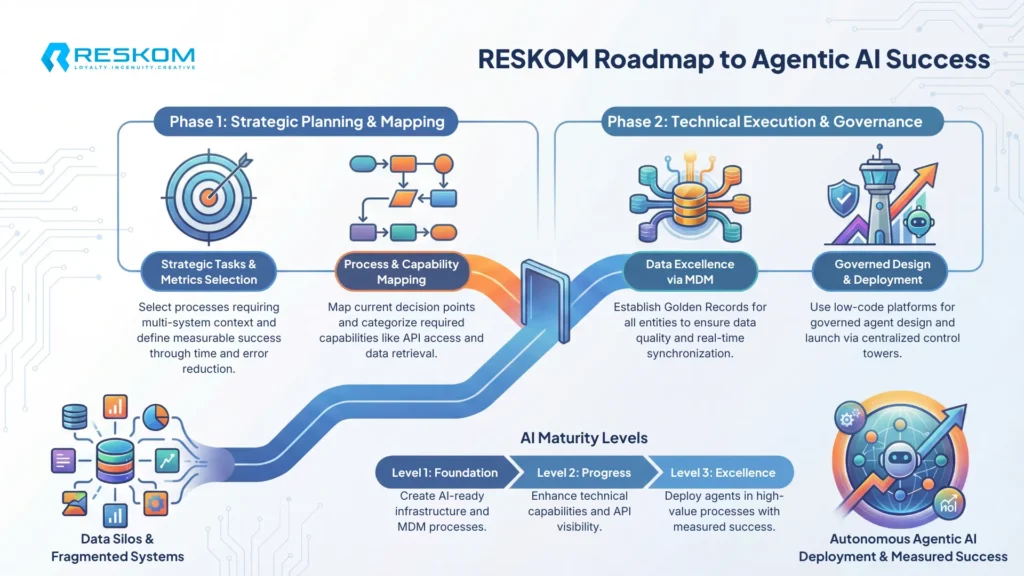
The Three Pillars of Agentic AI Success
Pillar 1: The Unified Data Foundation
Autonomous agents achieve their full potential when they have holistic entity views for informed decision-making. When customer data is synchronized across CRM systems, support databases, and transactional platforms in real-time, agents can establish comprehensive context and deliver accurate, valuable outcomes.
The Real-World Impact: Consider a customer service agent resolving a billing dispute. With a unified view spanning CRM records, payment history, and support tickets, the agent can quickly distinguish between legitimate complaints and processing errors. The result is decision-making based on complete data – building customer trust and eliminating manual intervention.
This unified foundation does more than just organize data; it provides the contextual grounding necessary to prevent AI ‘hallucinations.’ By using Boomi to fetch real-time data from disparate systems, agents operate with Retrieval-Augmented Generation (RAG) capabilities. This ensures that every autonomous decision is grounded in the most current ‘Golden Record’; such as real-time inventory from an ERP or live contract terms, rather than outdated training data.
Success Indicators:
- Unified customer views across all touchpoints
- Real-time data synchronization between systems
- Single source of truth for critical business entities
- Automated data quality monitoring with proactive remediation
Pillar 2: Strategic Agent Architecture
Leading enterprises deploy purpose-built autonomous agents supported by clear governance frameworks. This creates what analysts call “strategic agent ecosystems”—coordinated systems operating with comprehensive oversight, governance, and data integrity required for enterprise-grade autonomous operations.
The Competitive Advantage: When executive leadership demands AI initiatives, successful enterprises respond with strategic deployments that deliver measurable transformation. Forward-thinking organizations are establishing comprehensive governance frameworks, ensuring every agent operates with accountability and transparency.
Success Indicators:
- Centralized agent registry with complete visibility
- Automated governance and monitoring from deployment
- Clear accountability frameworks for agent actions
- Purpose-built agents for specific business processes
Pillar 3: Modern Infrastructure Readiness
Research from Alvarez & Marsal reveals an emerging opportunity: while enterprises have implemented 65% of basic digital capabilities, they can speed up toward the 39% foundational requirements needed for agentic AI. RESKOM maps this opportunity to four strategic enablers:
- Real-Time Data Pipelines: Event-driven architectures that support instantaneous decision-making for autonomous agents
- Automated Governance Frameworks: Scalable security policies that match the volume and speed of agent-driven decisions
- Modern API Infrastructure: Well-governed, monitored endpoints that provide secure, reliable access for autonomous systems
- Elastic Architecture: Cloud-native infrastructure that dynamically scales to handle variable agent workloads
Success Indicators:
- Event-driven integration architecture
- API management with automated discovery and governance
- Cloud-native, elastic infrastructure
- Automated security and compliance monitoring
The AI-Readiness Assessment Framework
Organizations can accelerate their AI maturity through systematic assessment and targeted improvement. RESKOM applies a three-pillar framework to guide customers through successful Boomi-based agentic AI programs.
Pillar 1: Data Foundation Maturity
Assessment Levels:
Level 1 – Foundation Building:
- Customer, product, or operational data exists in multiple systems
- Opportunity to implement systematic synchronization processes
- Starting point for master data management initiatives
- Ready to implement proactive data quality monitoring
Level 2 – Integration Progress:
- Point-to-point integrations connecting critical systems
- Automated synchronization for high-priority data entities
- Data quality monitoring for specific use cases
- Building toward exception handling automation
Level 3 – Data Excellence:
- Golden Record architecture implemented for critical entities
- Automated data pipelines with real-time synchronization
- Proactive data quality monitoring with automated remediation
- Single source of truth accessible across business units
Readiness Questions:
- How quickly can you produce a complete customer view spanning sales, service, and support?
- Which systems hold authoritative versions of each data entity?
- Can you trace data lineage from source through transformations to consumption?
- What opportunities exist to automate exception handling in data integrations?
Pillar 2: Technical Capabilities Maturity
Assessment Levels:
Level 1 – Automation Foundation:
- Workflows following defined business rules
- Opportunity to introduce intelligent exception handling
- Ready for centralized integration logic
- Foundation for API management implementation
Level 2 – Orchestration Excellence:
- Workflow engines coordinating multi-step processes
- Conditional logic handling business exceptions
- API layer with growing governance capabilities
- Building context-awareness across systems
Level 3 – Autonomous Operations:
- Systems demonstrating context-based decision-making
- Agents coordinating across multiple systems independently
- Comprehensive API management with automated governance
- Real-time visibility into agent actions and outcomes
This is where Boomi-plus-RESKOM architecture design becomes the catalyst, enabling autonomy with confidence.
Readiness Questions:
- What business processes are ready for autonomous decision-making?
- How comprehensive is your visibility into API endpoints?
- What opportunities exist for low-code integration development?
- Which workflows can benefit from reduced manual intervention?
Pillar 3: Governance & Security Excellence
Establishing Enterprise API Governance ensures that autonomous agents use secure, discoverable, and compliant API endpoints — a core requirement for enterprise agentic AI deployments.
Assessment Levels:
Level 1 – Building Governance:
- Security policies ready for systematic implementation
- Opportunity to implement API discovery and classification
- Foundation for automated compliance monitoring
- Ready to implement agent logging and monitoring
Level 2 – Governance Progress:
- Security frameworks with growing automation
- Expanding inventory of APIs and integration points
- Automated compliance monitoring for key regulations
- Agent logging with expanding analytics capabilities
Level 3 – Governance Leadership:
- Security and privacy controls embedded at the integration layer
- Automated discovery and classification of sensitive data
- Real-time compliance monitoring across all systems
- Centralized agent registry with complete accountability
RESKOM’s guiding principle: Every production agent should operate within a comprehensive governance framework.
Readiness Questions:
- What systems would benefit from enhanced API visibility?
- How can you accelerate sensitive data classification?
- What compliance monitoring capabilities can be automated?
- How can you establish comprehensive agent accountability?
The Readiness Opportunity Map
Organizations can chart their progress across all three pillars:
- Level 1: Foundation Building – Invest in data integration and MDM to create an AI-ready infrastructure
- Level 2: Integration Progress – Enhance governance and technical capabilities for agent readiness
- Level 3: Excellence Achievement – Deploy autonomous agents in strategic processes with measured success
Strategic Threshold: Organizations reaching Level 3 across all pillars are positioned to deploy autonomous agents that deliver measurable business value and competitive advantage.
The Solution Architecture - Building AI-Ready Infrastructure
Agentic AI readiness requires integration, data management, and governance to operate as a unified platform. RESKOM implements this using the Boomi Enterprise Platform as the strategic backbone.
RESKOM’s Boomi Integration Services help enterprises connect CRM, ERP, and operational systems into a real-time foundation required for autonomous agent execution.

Component 1: Building the Golden Record Foundation
The catalyst for autonomous reasoning is a “Single Source of Truth” for each critical business entity. This requires Master Data Management (MDM) capabilities that:
- Synchronize Data Across Systems: Automated bidirectional synchronization ensures updates in any source system propagate to the Golden Record and back to all dependent systems
- Establish Data Governance: Ownership rules, validation logic, and survivorship rules determine which source system holds authority for each data attribute
- Enable Real-Time Access: Agents access the Golden Record through APIs without batch delays or manual processes
Implementation Approach: Boomi DataHub provides MDM capabilities classified as “Exemplary” in ISG’s Buyer’s Guide for Master Data Management. The platform creates Golden Records through:
- Unified Hub Architecture: Centralized repository spanning CRM, ERP, e-commerce, and support systems
- Automated Synchronization: Real-time data flows ensuring consistency across business units
- Data Quality Rules: Built-in validation and cleansing at the point of ingestion
- API-First Access: Golden Records exposed through managed APIs for agent consumption
Component 2: Integration Platform as Strategic Infrastructure
The catalyst for autonomous reasoning is a “Single Source of Truth” for each critical business entity. This requires Master Data Management (MDM) capabilities that:
- Synchronize Data Across Systems: Automated bidirectional synchronization ensures updates in any source system propagate to the Golden Record and back to all dependent systems
- Establish Data Governance: Ownership rules, validation logic, and survivorship rules determine which source system holds authority for each data attribute
- Enable Real-Time Access: Agents access the Golden Record through APIs without batch delays or manual processes
Implementation Approach:
Boomi DataHub provides MDM capabilities classified as “Exemplary” in ISG’s Buyer’s Guide for Master Data Management. The platform creates Golden Records through:
- Unified Hub Architecture: Centralized repository spanning CRM, ERP, e-commerce, and support systems
- Automated Synchronization: Real-time data flows ensuring consistency across business units
- Data Quality Rules: Built-in validation and cleansing at the point of ingestion
- API-First Access: Golden Records exposed through managed APIs for agent consumption
Autonomous agents operate by invoking tools and accessing data across multiple systems. This requires an integration layer providing:
- Universal Connectivity: Pre-built connectors to common enterprise applications (Salesforce, SAP, Workday, NetSuite, etc.)
- API Management: Centralized governance of all API endpoints with automated discovery
- Real-Time Processing: Event-driven architecture supporting autonomous decision-making
- Scalable Infrastructure: Elastic runtime environments handling variable agent workloads
Implementation Approach:
The Boomi integration platform serves as the orchestration layer through:
- Low-Code Integration Development: Visual workflow design accelerating integration deployment by 4x compared to custom coding
- Connector-Based Architecture: Pre-built connectors eliminate custom API development needs
- Hybrid Deployment: Support for cloud, on-premises, and edge environments, ensuring universal connectivity
- Accelerated ELT Pipelines: The Data Connector Agent accelerates development by up to 30x for REST-based data sources
The FinOps Advantage: Optimizing AI Costs at the Gateway As agentic operations scale, uncontrolled token consumption can spiral costs. At RESKOM, we leverage the Boomi Enterprise Platform to act as an AI Gateway. By implementing Semantic Caching where Boomi recognizes and provides existing answers for similar queries, we eliminate redundant calls to expensive LLMs, ensuring your AI transformation remains economically sustainable while maximizing ROI.
Component 3: Agent Governance and Orchestration
Building strategic agent ecosystems requires centralized visibility and control over all autonomous systems. This enables:
- Agent Registry: Complete inventory of all agents, their permissions, and tool access
- Monitoring Infrastructure: Real-time visibility into agent actions, decisions, and outcomes
- Intelligent Guardrails: Least-privilege access controls that optimize agent effectiveness while managing risk
- Human-in-the-Loop (HITL) Orchestration: For high-stakes autonomous actions, Boomi enables ‘Human-in-the-Loop’ checkpoints. These workflows ensure that an agent can pause and request human approval via centralized notifications before executing critical business logic, blending autonomous speed with human oversight
- Comprehensive Audit Trail: Complete lineage from agent action through data access to business outcome.
Implementation Approach:
Boomi’s agent governance framework includes:
- Agentstudio: Code-free, prompt-driven agent creation with embedded governance controls
- Agent Control Tower: Centralized registry providing visibility across multi-provider agent environments
- Model Context Protocol (MCP) Support: Open standard enabling interoperability between agents, tools, and data sources
- Security by Design: Automated classification of sensitive data with region-specific protection policies through DataDetective
The Strategic Agent Suite: Purpose-Built Autonomous Systems
Rather than attempting to build general-purpose agents, successful organizations deploy specialized agents for specific integration and data management tasks:
Integration Acceleration:
- DesignGen: Natural language interface for creating integration workflows, eliminating manual coding
- HubGen: Autonomous synchronization workflows maintaining Golden Records across source systems
Data Governance Excellence:
- DataDetective: Automated discovery and classification of sensitive data with privacy policy enforcement
- Data Connector Agent: Accelerated ELT pipeline creation for REST APIs
Operational Intelligence:
- Scribe: Auto-generated documentation eliminating manual maintenance of integration specifications
- Answers: Intelligent support system leveraging collective user insights for issue resolution
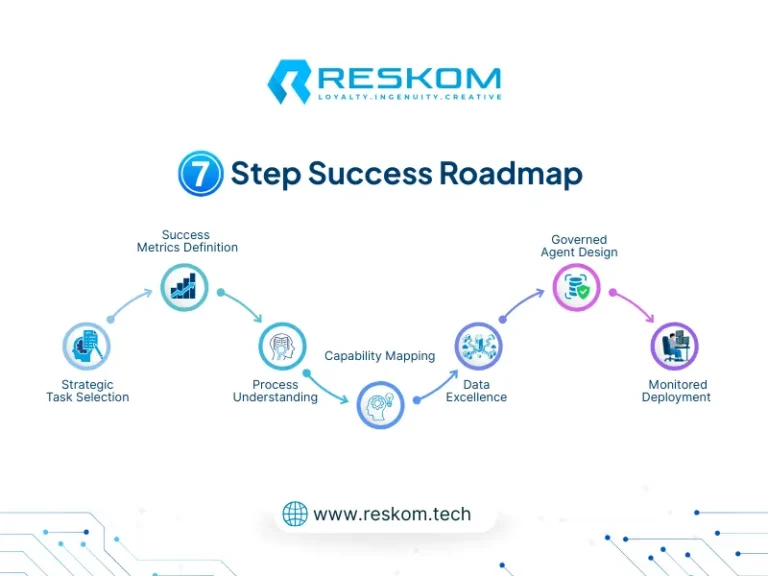
The RESKOM 7-Step Success Roadmap
RESKOM follows a proven 7-step approach when deploying successful agentic AI programs:
Step 1 – Strategic Task Selection: Identify high-value processes requiring context across multiple systems (example: 3-way invoice reconciliation matching purchase orders, receipts, and invoices)
Step 2 – Success Metrics Definition: Define ROI in measurable terms (time saved, error reduction percentage, manual interventions eliminated)
Step 3 – Process Understanding: Document current workflows, including decision points, data sources, and exception patterns
Step 4 – Capability Mapping: Categorize required capabilities (API access, data retrieval, decision logic, notification systems)
Step 5 – Data Excellence: Implement MDM for all entities the agent will interact with, ensuring data quality and synchronization
Step 6 – Governed Agent Design: Build agents using low-code platforms with embedded governance, security, and monitoring from day one
Step 7 – Monitored Deployment: Launch in controlled environments with real-time visibility through centralized agent control towers
Conclusion: The Strategic Opportunity
The current AI transformation presents an unprecedented opportunity: enterprises investing in foundational data architecture position themselves among the industry leaders delivering measurable ROI from autonomous agents. The winners in the agentic AI transformation are organizations recognizing a powerful truth: the sophistication of your AI models, combined with the integrity of your data fabric, creates sustainable competitive advantage.
A key part of this readiness is maintaining a Model-Agnostic Architecture. By utilizing Boomi’s native support for the Model Context Protocol (MCP), RESKOM ensures your data and tools are discoverable to any agentic ecosystem. This allows you to swap or upgrade AI models as the market evolves without rebuilding your entire integration architecture, preventing vendor lock-in and securing your long-term technology investment.
RESKOM’s experience enabling Enterprise AI Transformation shows that organizations investing early in data foundations consistently unlock measurable ROI from autonomous agent initiatives.
The Success Blueprint:
- Foundation First: Deploy autonomous agents with corresponding Golden Records in a master data management system
- Governance by Design: Register, monitor, and optimize every agent through centralized control systems
- Integration as Strategy: Leverage integration platforms as strategic infrastructure, enabling autonomous operations
The CIO’s Opportunity Framework:
- Building Foundation (Level 1): Invest in data integration and MDM to create an AI-ready infrastructure
- Accelerating Progress (Level 2): Enhance governance and technical capabilities for agent deployment
- Achieving Excellence (Level 3): Deploy strategic agents in high-value processes with measured success
The Visibility Opportunity: Organizations gaining comprehensive visibility into their integration landscape can strategically plan agent deployments for maximum business impact.
The path to autonomous enterprise operations leads through clean, connected, governed data. Organizations building this foundation transform AI from experimentation into sustainable competitive advantage. Those who invest strategically will lead their industries while establishing new standards of operational excellence.
The era of agentic AI has arrived. Your data infrastructure—and the strategic partners you choose—can position you to lead this transformation.
Start your journey with a structured AI Readiness Assessment to align data, integration, and governance before deploying autonomous agents and ensure a clear path to measurable outcomes.