
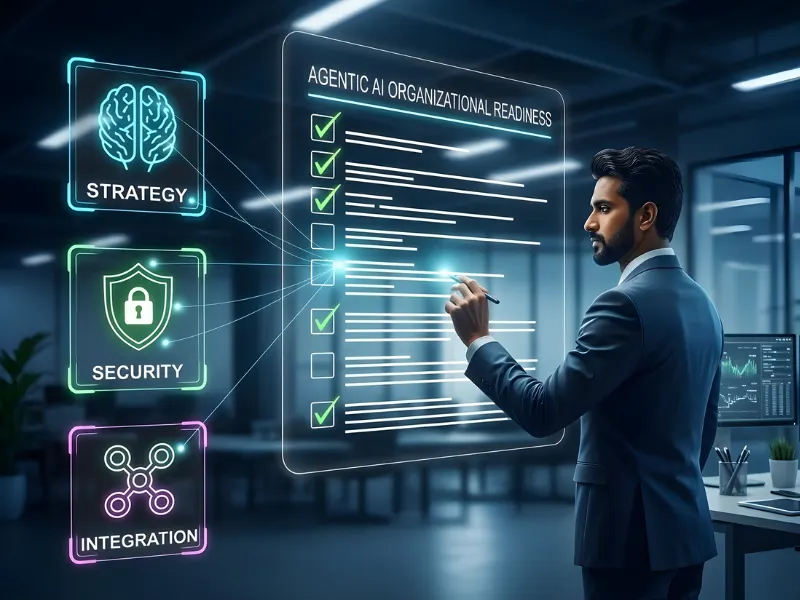
Boomi recently published an executive guide — Building the Agentic Enterprise: An AI Blueprint for CEOs. It offers a strong foundation for organizations preparing to deploy Agentic AI. The guide outlines five key pillar: integration, automation, data management, API management, and AI agent governance that together form a practical readiness framework for modern enterprises. This framework also aligns with what many CIOs consider an essential Agentic AI Checklist for evaluating enterprise readiness before deploying autonomous AI systems.
At RESKOM, in our work with small and mid-market enterprises across industries, we have found that platform readiness and organizational readiness are often treated as the same problem, but they are not.. In this blog, we offer a complementary checklist to Boomi’s blueprint addressing the organizational factors that sit alongside the platform capabilities, particularly for SMEs where constraints and risk profiles differ from large scale deployments.
CIO TL;DR
- Most Agentic AI frameworks focus on platform capability: integration, automation, data, APIs, and agent governance.
- For mid-market enterprises, platform readiness alone is not enough.
- CIOs must also evaluate operating model ownership, security architecture, talent depth, legacy debt, and change management before committing to an agentic AI roadmap.
- Based on our experience working with mid-market organizations, CIOs should evaluate the following five organizational readiness factors before committing to an Agentic AI strategy.
Operating Model Readiness
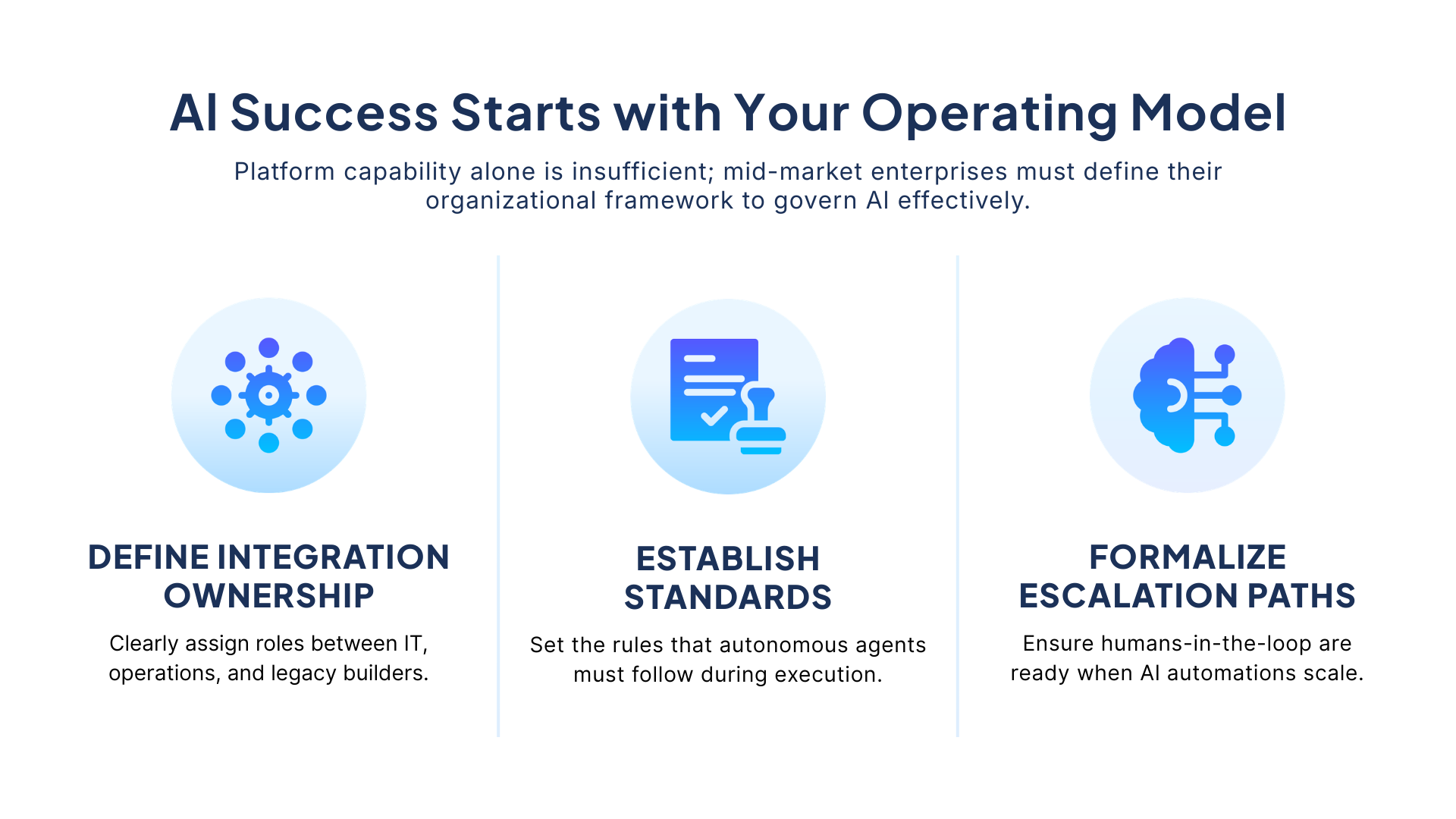
Before integrating systems at scale, CIOs must define clear ownership for integration architecture and operations.. At mid-market scale, integration ownership is often split between IT, operations, and legacy point-to-point builders.
No iPaaS platform, however capable, can substitute for a clear operating model. RESKOM advocates for Operational Simplicity. We help you define roles, accountability, standards, and escalation paths so that when AI agents start automating at scale, they aren’t amplifying existing disorder.
Security Architecture
The Boomi guide rightly flags API security risks — including shadow APIs and zombie APIs. But for Agentic AI, the threat surface is wider. When autonomous agents authenticate across systems, executing transactions, and handling sensitive business data, the security architecture must support identity management, secrets handling, zero-trust principles, and agent level audit logging .
For mid-market enterprises without a dedicated security team, this is not a detail to defer. It is a prerequisite. Our senior-led teams focus on building Zero-Trust principles directly into your Boomi environment from day one.
Skills and Talent
Low-code tools lower the barrier to building integrations. They do not however lower the barrier to designing them well. Agentic workflows introduce new complexity — orchestration logic, error handling, human-in-the-loop checkpoints, and agent observability.
Mid-market organizations should ask: Does my team have the internal capability to govern what they are building? If the answer is no, RESKOM will provide certified Boomi architects. We ensure your internal team can manage the platform long-term, reducing your Total Cost of Ownership (TCO).
Legacy Debt Assessment
You cannot integrate what you have not mapped. Many mid-market enterprises lack a current, accurate inventory of their integration touchpoints, API endpoints, and data flows. Skipping this assessment rarely saves time. It simply defers risk to the implementation phase, where problems are typically 10x more expensive to fix.
The RESKOM Edge: If your legacy debt is tied up in platforms like MuleSoft, we don’t start from scratch. We utilize our proprietary Renova Framework—an AI-powered migration tool that automates up to 60% of asset conversion. This allows us to clear your legacy debt and move you to Boomi with the speed of a specialist team.
Change Management
Agentic AI does not just change what systems do. It changes what people do. Roles shift as approval workflows are automated. Decision-making moves closer to the machine. For mid-market organizations, where teams are leaner and change lands harder, this human dimension is often the variable that determines whether a transformation succeeds or stalls. Technology readiness without organizational readiness is an incomplete investment.
The Bigger Picture
Boomi’s five-step framework is a valuable platform readiness lens. But CIOs — particularly those leading mid-market enterprises where resources are finite and missteps are costly — need to hold a wider frame. Platform readiness and enterprise readiness are related but fundamentally different questions.. The former tells you whether your technology can support agentic AI. The latter tells you whether your organization can govern it responsibly.
Getting both right is what separates enterprises that deploy agentic AI from those that derive sustained value from it.
RESKOM is a 100% Boomi-exclusive implementation partner. We specialize in integration architecture, API governance, and modernization for mid-market enterprises. If you are evaluating your organization’s readiness for agentic AI, we would welcome a conversation to understand your architecture and strategic priorities.. Contact us for getting started.
FAQs
What is an Agentic AI checklist?
An Agentic AI checklist helps CIOs evaluate whether their organization is ready to deploy autonomous AI agents by assessing integration, governance, security, talent, and operational readiness.
Why do CIOs need an Agentic AI checklist?
CIOs need an Agentic AI checklist to ensure both technology platforms and organizational processes are prepared before deploying AI agents that automate decisions and business workflows.
What are the key components of an Agentic AI strategy?
A strong Agentic AI strategy includes integration architecture, API management, automation, data governance, security frameworks, and AI agent oversight.
How is Agentic AI different from traditional automation?
Traditional automation follows predefined workflows, while Agentic AI uses autonomous agents that can make decisions, interact with systems, and adapt to changing conditions.
What risks should enterprises consider before implementing Agentic AI?
Enterprises should evaluate risks such as API security vulnerabilities, shadow APIs, legacy integration debt, governance gaps, and lack of skilled AI integration talent.
How can mid-market enterprises prepare for Agentic AI adoption?
Mid-market enterprises should start with a readiness assessment covering operating models, integration platforms, security architecture, talent capabilities, and change management.